
Common Digital Marketing Mistakes to Avoid
Digital marketing has changed the way businesses attract, engage, and retain customers. However, even a professional marketer or SEO specialist can make costly mistakes. From unmanaged ad spending to ignoring mobile users, technical aspects can waste resources and negatively impact your brand’s reputation.
In this blog, we will guide you through the most common digital marketing mistakes and how you can avoid them based on real-world experience and trusted industry practices.
Why Avoiding Mistakes is Critical in Digital Marketing
Digital marketing is an investment in the right strategies to increase your business and its revenue. One wrong move can cost thousands in lost revenue in a competitive landscape. For example, poor targeting, low-quality content, or mismanaged budgets can quickly sink even the most creative campaigns. That's why avoiding mistakes is important in digital marketing.
Common Digital Marketing Mistakes and How to Avoid Them
1. Not Defining a Clear Target Audience
The Mistake: Targeting everyone instead of your ideal customer based on a niche.
Why It Hurts: Your approach becomes too generic, and your budget gets wasted.
How to Fix It:
• Create a target audience persona such as age, gender, locations, interests, and user behavior.
•Use auditing tools like Google Analytics and Meta Audience Insights for real data.
• Segment your audience for more relevant campaigns.
2. Ignoring Mobile Optimization
The Mistake: Only focus on desktop optimization.
Why It Hurts: More than 60% of web traffic will come from mobile in 2025; if your website loads poorly or is not optimized, users might exit.
How to Fix It:
• Use responsive web design.
•Test your site with Google’s Mobile-Friendly Test.
• Optimize images and compress files for faster load times.
3. Overlooking SEO Basics
The Mistake: ignoring essential SEO practices.
Why It Hurts: Search engines can’t properly index your content, lowering visibility.
How to Fix It:
• Use descriptive meta titles and meta descriptions.
• Add alt text to images.
• Improve site speed and fix broken links.
• Follow Google’s Helpful Content Guidelines like EEAT.
4. Relying Too Heavily on Paid Ads
The Mistake: Only focusing on paid ads over organic traffic.
Why It Hurts: Ads stop working when budgets stop, and your traffic will disappear.
How to Fix It:
• Work on long-term strategies and balanced paid ads with SEO, email marketing, and social content.
• Plan a long-term SEO plan to increase organic growth.
5. Not Tracking Campaign Performance
The Mistake: campaigns without monitoring results.
Why It Hurts: If you do not track, you cannot improve.
How to Fix It:
• Set clear KPIs (click-through rate, conversion rate, cost per acquisition).
•Use Google Analytics, GA4, or HubSpot to track performance.
• Review reports weekly to make timely changes.
6. Ignoring Content Quality
The Mistake: Creating generic content with keyword stuffing.
Why It Hurts: Damages your credibility and search rankings.
How to Fix It:
• Draft content based on user intent.
• Create content that is informative, engaging, and well-structured.
• Focus on solving the problems rather than explaining.
• Update old content to stay relevant.
7. Forgetting About Email Marketing
The Mistake: Thinking email is “dead.”
Why It Hurts: Email still has one of the highest ROI rates in digital marketing.
How to Fix It:
• Build an opt-in email list.
• Send personalized, value-driven emails.
• Avoid spammy language and keep subject lines clear.
How to Audit Your Digital Marketing Strategy
Quick Brainstorm:
1. Who is my target audience?
2. Is my website mobile-friendly?
3. Are my SEO basics in place?
4. Do I have both paid and organic strategies?
5. Am I tracking results regularly?
Conclusion
Digital marketing success isn’t just about what you do—it’s also about what you don’t do. By avoiding these mistakes and applying proven strategies, you can save money, build stronger customer relationships, and boost your brand’s visibility.
If you’re unsure where to start, a professional digital marketing training can quickly uncover growth opportunities.

Why MERN Stack is the Future of Web Development in 2025
Introduction
The digital world is evolving day by day, and web development is no exception to the trends and demands. AI and new frameworks, technologies, and tools are introduced every year; however, only some of them get user attraction and stay relevant in the market. Among the many development stacks, MERN Stack has consistently grown in popularity. It has a strong combination of MongoDB, Express.js, React, and Node.js.
A go-to choice for developers, startups, and even enterprise applications, the MERN stack has firmly established itself in 2025. But the question is, why should a developer invest time to learn the MERN stack? Why is this so special?
In this blog, we will discuss its advantages, what the MERN stack is, its use cases, and why it is the future of web development.
What is MERN Stack Web Development?
This is a full-stack web development framework used to build web applications. It is a JavaScript-based technology. It is the combination of:
• MongoDB—it is a NOSQL database for storing data in JSON-like format.
• Express.js—A backend framework for building APIs and handling server-side logic.
• React—A frontend library for creating dynamic, responsive user interfaces.
• Node.js—A runtime environment that allows JavaScript to run on the server.
The advantage of the MERN stack is that you can use JavaScript for both backend and frontend to develop faster, efficient, and reliable web applications.
Why MERN Stack is Gaining Popularity in 2025
Here are several reasons why the MERN stack is becoming the future of web development.
1. JavaScript Dominance – Based on the Stack Overflow 2025 survey, JavaScript is the most used programming language in the world.
2. Full-Stack Capability – It allows developers to work on frontend and backend without switching languages, which makes the process easier.
3. Community Support – As this is the most used language, it has a larger community, so developers can get easy support. MERN has a huge open-source community that continuously improves its tools.
4. Industry Adoption—Popular and trusted industries like Netflix, Uber, and Instagram have leveraged this technology, which has also increased the trust and reliability of the MERN stack.
Key Advantages of MERN Stack for Developers
1. Single Language Across the Stack
Working on a single language from database to UI reduces the switches and makes faster learning for beginners.
2. High Performance & Scalability
• Node.js enables non-blocking, event-driven architecture for fast performance.
• MongoDB scales easily to handle large amounts of data.
3. Rich User Interfaces with React
Using React as a frontend increases the code reusability and speeds up UI development
4. Cost-Effective Development
Since all MERN technologies are open-source, businesses save significantly on licensing fees.
Popular MERN Stack Use Cases in 2025
• Creating e-commerce platforms such as dynamic product catalogs and secure transactions.
• Developing real-time applications like chat applications, live-tracking systems, and collaboration tools.
• Developing SaaS Platforms—Subscription-based software for various industries.
• It is also used to create portfolios and business websites with fast, interactive, and responsive interfaces.
Challenges & Limitations
• Learning Curve—since this is full-stack technology, it needs to be familiar with JavaScript, backend concepts, and the React ecosystem.
• SEO Limitations – React apps may not fully support SEO unless paired with next.js or server-side rendering.
• Security Risks – As this is a web application development framework, it needs proper authentication and data protection.
The Future of MERN Stack in Web Development
With the increasing use of AI and machine learning, the MERN stack is expected to integrate more in 2025 and beyond with:
• AI and Machine Learning—Smarter apps with real-time personalization.
• Cloud & Serverless—Faster deployments using AWS Lambda, Vercel, and Netlify.
• Progressive Web Apps (PWAs)—Offline-capable, app-like experiences in the browser.
Job market outlook: Demand for full-stack developers proficient in MERN is projected to remain strong, especially in startups and SaaS companies.
Conclusion
The MERN stack has moved beyond being a “developer trend”—it’s now a core toolkit for building modern, scalable, and high-performance web applications. Whether you’re a student starting your coding journey or an experienced developer looking to upgrade your skills, learning MERN in 2025 is a strategic career move. If you want more about this, explore our MERN Stack development training.

How Python Powers AI and Machine Learning
AI and ML are shaping the present; they are no longer futuristic concepts. Python helps artificial intelligence and machine learning, from ChatGPT assistants to autonomous cars and advanced healthcare diagnostics systems. AI is ruling everywhere; however, this innovation lies in a familiar language: Python.
Despite there being many programming languages in the market in 2025, Python is continuously dominating in AI and ML development. In this blog, we will discuss why Python remains the go-to choice for AI and how it is powering real-world innovations.
Why Python Remains Dominant in AI & ML (2025)
Other languages are growing in competition, like Julia, Rust, and others in AI-specific languages, but Python's dominance is insane.
- Beginner-friendly syntax—This is a very beginner-friendly programming language; its readable code makes it accessible for students, researchers, and professionals.
- Huge community support—the number of Python users is in the millions, and the developers contribute to open-source projects, GitHub repositories, and AI-focused forums.
- Cross-platform capability—it works seamlessly on macOS, Windows, Linux, and even embedded systems.
If you search “Why Python for AI” or “Python machine learning 2025,” you’ll see most guides still place Python at the top.
Key Python Libraries Driving AI and ML in 2025
Python has a larger ecosystem of libraries and frameworks, and from this, Python powers AI and ML systems.
- TensorFlow 3.x—it is an advanced deep learning framework and optimized for GPU/TPU performance.
- PyTorch 2.x—It is useful for research and production with native support for dynamic computation graphs.
- Scikit-learn—still the go-to for classical ML models like regression, clustering, and decision trees.
- Pandas & NumPy—these are the core tools for data manipulation, cleaning, and numerical computation.
Python’s Role in Emerging AI Trends (2025)
Python is not limited to data science in 2025; it is integrating into every sector. Python has become a center of attraction, like
- Generative AI—This AI model is used for building text, images, and even code using AI models like Cursor AI and GPT-based APIs.
- Edge AI—Running Python-based AI models on devices like drones, cameras, and IoT sensors for real-time decision-making.
- AI Automation Pipelines—this AI model is used for automating everything from data ingestion to model deployment, like automatic cars, Robert, and autopilot machines.
Real-World Python AI Applications
Python is ruling over almost every industry, as people are preferring automation over manual work due to budget and manpower constraints.
- Healthcare—AI and ML are used to detect the early stages of disease from medical scans.
- Finance—The banking and finance sector is using AI models for fraud detection and stock market forecasting to automate reports and analytics.
- Autonomous Vehicles—AI models are used on autonomous vehicles for navigation systems, autopilot mode, and obstacle detection.
- Marketing—Many organizations are using AI models to create content, making videos and editing images and creating different kinds of campaigns for customer engagement.
Career Opportunities: Python + AI in 2025
If you are looking for a future in AI and ML in 2025 and beyond, Python can be a strong bet.• AI Engineer – Develops AI models for various applications.
• Machine Learning Engineer – Builds, trains, and deploys ML models.
• Data Scientist – Analyzes and interprets large datasets to extract insights.
Salary ranges (average in Nepal):
• Entry-level: 600k – 800k/year
• Experienced: 1200k – 2000K/year
Challenges & Limitations
Python is a powerful language, but it is not perfect; it has certain limitations on the execution process.
• Speed Limitations—Python is slower than low-level programming languages like C++ for executing heavy tasks.
• Library Dependence—This is extremely dependent on external packages.
• Competition—Other languages like Julia and Rust are gaining popularity for AI due to performance advantages.
Conclusion
Python is gaining popularity because of its simplicity, massive library support, and adaptability to new AI trends, ensuring it stays relevant well into the future. In 2025, Python is still ahead in the game of AI and the ML field. If you are looking to build your career in AI and ML, explore our Python training with AI & ML to learn more about it.

How to Become a Professional Video Editor
Video content is dominating social media, marketing, entertainment, and even the educational field. You can find videos everywhere, from short-form TikTok reels to cinematic films. Due to the trend of videos in the market, there is a high demand for professional video editors. Shaping the way audiences experience visual storytelling.
Have you been impressed by a seamless transition, a powerful montage, or a perfectly timed use of elements? It's obvious that you have seen the magic of video editing; however, the question is, how do you turn that magic into a career? In this blog, we are going to guide you to become a professional video editor.
Understanding the Role of a Professional Video Editor
First of all, you need to understand the role of a professional video editor; it is more than someone who cuts and trims video clips.
They:
• Craft a story from raw footage.
• Maintain pacing to keep viewers engaged.
• Balance visuals, sound, and motion graphics for emotional impact.
Common editing projects include:
• Films & documentaries for movies and media houses.
• Commercials & advertisements for agencies and organizations.
• YouTube & social media content for personal branding and vlogging.
• Event videos (weddings, concerts, and corporate events) as a freelancer or business.
• Training and educational videos to educate people and beginners.
Pro Tip: Great editors don’t just follow instructions; they bring creative ideas to enhance the final product.
Essential Skills Every Video Editor Must Have
Here are the most essential skills to become a professional video editor in Nepal.
Technical Skills
• Mastery in powerful editing software like Adobe Premiere Pro, Final Cut Pro, and more.
• Color grading to make an attractive tone and mood to match storytelling.
• Editing sound to balance audio, removing background noise, and syncing dialogue.
• Knowing how to export in the right setting for file formats and codes for each platform.
Creative Skills
• Creating the flow from the clip for storytelling, even from unrelated clips.
• Understanding the pace and when to speed up or slow down footage for maximum impact.
• Attention to details, spotting tiny continuity errors before anyone else does.
Learning Path to Become a Professional Video Editor
Here is how you can be a professional video editor:
Step 1: Learn the basics through YouTube tutorials or platforms like Skillshare, Coursera, and Udemy.
Step 2: Choose your primary editing software and stick with it until you’re confident.
Step 3: Practice with real footage. You can download free stock videos from sites like Pexels and Mixkit.
Step 4: Learn supporting skills like motion graphics in After Effects or basic sound design.
Step 5: Build a portfolio with 3–5 of your best projects and a professional showreel.
Tools & Software to Master.
• Adobe Premiere Pro – Industry gold standard for professional work.
• Final Cut Pro – Perfect for Mac workflows and speed.
• DaVinci Resolve – Best for advanced color grading and free beginner access.
• After Effects – For motion graphics, animations, and visual effects.
• Audio Tools—Adobe Audition, Logic Pro, or Audacity for sound editing.
Building Your Portfolio & Online Presence
Your portfolio is your digital resume. Here’s how to make it shine:
• Create a showreel under 90 seconds, featuring your best work.
•Upload to Vimeo, YouTube, or Behance.
• Maintain an updated LinkedIn and connect with production professionals.
• Network in online communities like Reddit’s r/editors or Facebook groups for filmmakers.
Career Opportunities for Video Editors
Full-time roles: you can work as a full-time employee in media houses, advertising agencies, or corporate marketing teams.
Freelance & contract roles: You can collaborate with influencers, brands, and production companies to promote their brands.
Specialized niches: You can select specific niches like wedding films, sports highlight reels, short documentaries, and music videos as a business or with brands and companies.
Challenges & How to Overcome Them
Every profession has some challenges, but we can overcome them if we handle them with care and smartly. In video editing, there might be certain challenges, like
• Tight Deadlines: Sometimes you need to work extra to maintain deadlines, so use project management tools like Trello or Jira.
• Creative Blocks: Watch other editors’ work for inspiration and try to be creative and innovative.
• Software Updates: This can be another headache for the video editors. Stay updated with new features to remain competitive.
Conclusion
A professional video editor needs to have a set of technical skills, creativity, and adaptability. The industry is evolving, but video content consumption continues to rise—meaning your skills will always be in demand.
If you’re ready to turn your creativity into a career, start learning, keep practicing, and never stop experimenting. Your next edit could be the one that goes viral. If you're interested in learning about video editing training in Nepal, explore this resource.

The Impact of AI on the Future of Graphic Design
Graphic design was once a purely human-driven creation, but nowadays it is being reshaped by creative AI tools that can create an image, design a layout, and even suggest multiple creative ideas within seconds. This industry also cannot stay away from the artificial intelligence storm.
In 2025, artificial intelligence is not just an assistance tool; it is becoming a creator tool. The question is, what about the future of graphic design? Will designers be replaced by AI, or will it be a new alternative for creativity? In this blog, we will discuss the trends, tools, and opportunities shaping these transformations.
The Evolution of Graphic Design with AI
This field has always evolved alongside artificial intelligence. It started from the printing press to Photoshop. This field is powered by the latest technology, like machine learning, neural networks, and natural language processing (NLP).
• Before AI: The graphic designers were dependent on manual designing skills and tools like Adobe Illustrator, InDesign, and Photoshop.
• With AI: With AI, certain tasks can be done instantly, like generating a basic image, removing background, resizing images, or creating variations of UI and mockups.
• Example: Tools like ChatGPT and Adobe Firefly can generate realistic images from simple instructions, while Canva can generate the presentation layout in seconds.
Current Applications of AI in Graphic Design
1. AI-Assisted Creativity
It suggests that designers brainstorm concepts with layouts, color palettes, and typography combinations.
2. Automated Design Tasks
This application makes it easier for time-consuming tasks like object removal, background change, and image enhancement.
3. Generative Design Tools
Some advanced tools like ChatGPT and other designing tools can create logos, illustrations, and even complex artwork based on simple prompts.
4. Personalized & Data-Driven Designs
AI can analyze the user data and create targeted marketing visuals for personalized ads and social media content.
Popular AI Tools in 2025:
• Canva Magic Design: It is popular for quick layouts for non-designers and professionals, too.
• Adobe Firefly—It helps to create descriptive images and art.
• Midjourney – Hyper-realistic creative imagery.
• Figma AI Features—It suggests a design for the UI/UX projects.
What are the benefits of AI in graphic design?
1. Speed & Efficiency – AI reduces hours of work to minutes.
2. Cost Reduction – Small businesses can produce high-quality designs without large teams.
3. Accessibility—non-designers can create professional visuals easily.
4. Creative Expansion – AI introduces styles and layouts designers may not have imagined.
5. Collaboration—AI acts as a digital design partner, assisting with idea execution.
Challenges and Concerns
• Creativity vs. Originality—It can assist with designs, but it cannot be independent without superior human input.
• Job Displacement – AI can reduce the demand for entry-level designers due to automation in basic graphic design.
• Ethical & Copyright Issues – Who owns AI-generated art? This remains a legal grey area.
• Over-Reliance on AI – Designers risk losing core skills if they depend too much on automation.
The Role of Human Designers in an AI-Driven Future
While AI can produce fast, high-quality results, it lacks human empathy, cultural understanding, and emotional storytelling. The future belongs to designers who combine creative vision with AI efficiency.
Here are some skills to stay relevant in the future.
• Advanced UX/UI Design knowledge
• Storytelling & Branding expertise
• Prompt engineering for better AI outputs
• Cross-platform design adaptability
Best AI Tools for Graphic Designers in 2025
1. Adobe Firefly—Text-to-image generation with professional quality.
2. Canva Magic Design – Instant templates and layouts.
3. Midjourney – Artistic and hyper-realistic imagery.
4. DALL·E 3 – AI-powered illustration and concept art.
5. Runway ML—Video and creative editing automation.
6. Figma AI—Smart design recommendations for UI/UX.
How to Adapt AI as a Graphic Designer
• Learn AI Tools – Stay up to date with new trends and AI-powered design software.
• Develop a Signature Style—Develop core designing skills and make sure your work stands out from generic AI outputs.
• Understand AI Ethics—Understand the copyright and licensing terms and conditions for AI content.
• Join Creative AI Communities—Work in a group and share ideas, and learn from others.
Conclusion
AI might cut certain portions of jobs, but it helps to transform the way you work. AI helps to reduce repetitive tasks by automating and enhancing creativity possibilities. AI allows designers to focus on strategy, storytelling, and unique artistic expression.
The future of graphic design lies in human-AI collaboration, where technology handles efficiency, and humans bring heart and imagination to every project. If you want to learn more about graphic design, go and explore our graphic design training in Nepal.

How to Secure Your WordPress Site from Hackers
Over 43% of all websites on the internet are made from WordPress, which is making it the most popular CMS in the world. However, it has a risk with popularity; WordPress websites are often targeted by hackers. There are certain attacks, like brute force attacks and malware injections, and cybercriminals are constantly looking for vulnerabilities to exploit.
When your website is compromised by a hacker, you may lose your SEO ranking, valuable data, and customer trust within seconds. However, you can protect your website with the right security and protocol. In this blog, we will guide you through exactly how to secure your WordPress site from hackers in 2025 and beyond.
Understanding How Hackers Target WordPress Sites
Hackers use common vulnerabilities to attack the site; they do not just guess a website to attack. Here is the list of the most common attack methods used by hackers.
• Brute Force Login Attacks: Basically, hackers guess your username and passwords until they find the right one.
• Malware Injections: Hackers add malicious code into your website to get data or display spam.
• SQL Injections & XSS (Cross-Site Scripting): Injecting harmful scripts through insecure input fields.
• Theme & Plugin Vulnerabilities: They can enter your site through the outdated or poorly designed plugins and themes.
• Phishing via Contact Forms: Tricking you into sharing sensitive login credentials.
Basic Security Practices Every WordPress Owner Should Follow
If you are learning WordPress or you are a WordPress website owner, you should know the basic security practices.
• Keep WordPress Updated: Keep your website up-to-date for security patches.
• Update Themes & Plugins: Always keep your plugins and theme updated; an old version can be a hacker’s dream.
• Delete Unused Themes & Plugins: Unused files and themes can be vulnerable.
• Download Only from Trusted Sources: Only use and download themes and plugins from trusted sources, and avoid pirated resources.
Strengthening WordPress Login Security
Your login page is the front door to your website. Strengthening it is essential:
• Use strong usernames and passwords to avoid being predictable for hackers.
• Enable two-factor authentication to protect your login. You can use apps like Google Authenticator.
• Use plugins for limiting the login attempts; if someone is attempting the wrong login, it will block the user.
• Change the default login URL to avoid bots from finding your login page; it will make it harder to find.
Using WordPress Security Plugins
A good security plugin acts like a 24/7 guard for your site.
Top Options in 2025:
• Wordfence—Real-time firewall & malware scanner.
• Sucuri Security – Cloud-based firewall and monitoring.
• iThemes Security – 30+ security features in one plugin.
• All In One WP Security—Great for beginners.
Secure Your WordPress Hosting
Even if your website is secure, if your hosting has a vulnerability, hackers can still get into your site.
• Choose a reputable hosting provider with security features.
• Consider managed WordPress hosting (like Kinsta or WP Engine) for automatic security updates.
• Enable server-level firewalls & daily malware scans.
Protect Your Site with SSL Encryption
SSL (Secure Sockets Layer) encrypts data between your website and visitors. It’s essential for security and SEO.
• Install an SSL Certificate—Most hosts provide free Let’s Encrypt SSL.
• Ensure your site uses HTTPS instead of HTTP.
Regular Backups and Recovery Plans
Backups are your insurance policy in case of an attack.
• Use backup tools like UpdraftPlus, BlogVault, or Jetpack Backup.
• Schedule daily or weekly backups depending on site activity.
• Store backups in cloud storage like Google Drive or Dropbox.
Monitoring and Detecting Suspicious Activity
Detect threats early before they cause damage.
• Set up security alerts with your security plugin.
•Use Google Search Console to check for security issues.
• Regularly scan your site for malware.
Conclusion
Securing your WordPress site is not a one-time task; it’s an ongoing process. By keeping your site updated, using strong login protection, installing security plugins, and performing regular backups, you can greatly reduce the risk of being hacked.
The digital world is constantly evolving, and so are hackers. Stay informed, be proactive, and treat your website like the valuable asset it is.

Common AC Problems and How to Fix Them
During the summer peak time, the only thing you want is your air conditioner to be at your comfort level. Sometimes AC can give you problematic days and nights; however, there is always a solution for every problem. A little troubleshooting can fix the most common issues, but you need to contact a professional for maintenance and repairable problems. In this article, we will be discussing the most common AC problems, their reasons, who can fix them, and how to fix them. And also providing the tips to keep your cooling system smooth and running effectively all year round.
Here are the most common AC problems and tips on how to fix them:
1. AC Not Cooling Properly
Symptoms: AC turns on but fails to provide cooling air.
Possible Causes:
• Dirty or clogged air filter.
• Leaks and low levels of the refrigerant
• Faulty thermostat settings.
How to Fix:
• Every 1-3 months, clean or replace the air filter.
• Test that the thermostat setting is on "cool."
• If refrigerant is low, call a professional so that the refrigerant can be checked and corrected (mechanic must be certified to handle refrigerant).
Pro Tip: A dirty filter is the one cause of weak cooling performance.
2. AC Not Turning On
Symptoms: The unit doesn’t start at all.
Possible Causes:
• Tripped circuit breaker or blown fuse.
• Dead thermostat batteries.
• Faulty wiring or electrical issues.
How to Fix:
• If they are, unplug the coffee maker—and possibly reset a breaker or replace a fuse.
• Change thermostat batteries and check the settings.
• Look for any signs of blisters or breaks in electrical wiring (Don't try to fix this yourself.)
3. Weak Airflow from Vents
Symptoms: Very weak, cool air emerges.
Possible Causes:
• clogged air ducts or a dirty air filter.
• A broken blower motor
How to Fix:
• Change the air filter.
• Clean and check ducts for obstructions.
• Make an appointment for expert maintenance if the blower motor is broken.
4. Water Leaks Around AC Unit
Symptoms: Water puddles surrounding the indoor unit.
Possible Causes:
• A dirty filter or clogged air ducts
• Faulty blower motor.
How to Fix:
• Clear the clogged drain line with a wet/dry vacuum.
• Before restarting, turn off the air conditioner and allow the frozen coils to thaw.
• Make sure you have enough insulation to stop freezing again.
5. Strange Noises from AC
Symptoms: AC can produce a buzzing, rattling, grinding, or squealing noise.
Possible Reasons:
• AC screws or panels may be loose.
• Worn-out fan belts or motor bearings.
• Debris stuck inside the outdoor unit.
Solutions:
• Tighten loose screws or panels, if any
• Clear debris from around the outdoor condenser.
• Change the worn-out parts carefully to avoid serious damage.
6. Bad Odours from AC
Symptoms: You may smell musty, burning, or chemical odors from the AC.
Possible Reasons:
• Mold or mildew growth inside the unit.
• The wiring circuit might burn out.
• The drain pans might have stagnant water.
Solutions:
• Replace filters and clean coils with an antibacterial cleaner.
• Check and inspect burnt wiring from electricians.
• Clean and dry the condensate pan.
7. AC Constantly Running
Symptoms: AC can run even if the room temperature is cool.
Possible Reasons:
• The thermostat setting might have been incorrect.
• Due to dirty condenser coils.
• Undersized unit for your room size.
Solutions:
• Check and reset the thermostat to maintain the desired temperature.
• Clean condenser coils to improve efficiency.
• If undersized, consider upgrading to a properly rated unit.
8. Preventive Maintenance Tips
Here are certain maintenance tips to keep your AC in perfect condition, which can save money and prevent breakdowns.
• Regularly change the air filters.
• Book annual professional servicing for the AC.
• Maintain your outdoor unit free from dust and debris.
• Use a programmable thermostat for energy efficiency.
9. When to Call a Professional for AC Repair?
Some common basic maintenance tasks can be done by do-it-yourself (DIY), but in hardware and software cases, you need an expert's help.
• Refrigerant leaks or recharge.
• Electrical wiring repairs.
• Persistent problems after troubleshooting.
10. Safety Precautions
• Always turn off the power before opening the unit.
• Avoid handling refrigerant without certification.
• Wear gloves and protective eyewear when cleaning.
Conclusion
In this blog, we have mentioned the most common AC problems, such as dirty filters, clogged drain lines, or thermostat issues that can be solved with simple fixes. In some cases, like refrigerant leaks, major electrical problems, and complex mechanical failure, it’s better to call a professional. By combining preventive maintenance with prompt troubleshooting, you can ensure your AC runs efficiently, keeps your home cool, and lasts for years.
FAQs
Q1. How often should I change the air filter in my AC?
Every 1-3 months, clean or replace the air filter. A dirty filter is the one cause of weak cooling performance.
Q2. Why is my AC not cooling properly even though it is running?
Possible causes include a dirty or clogged air filter, leaks and low levels of the refrigerant, or faulty thermostat settings. Test that the thermostat setting is on "cool." If refrigerant is low, call a professional.
Q3. What should I do if my AC is not turning on at all?
Check for a tripped circuit breaker or blown fuse, dead thermostat batteries, or faulty wiring. Change thermostat batteries and check the settings. Look for any signs of blisters or breaks in electrical wiring (Don't try to fix this yourself.)
Q4. Why is there weak airflow from my AC vents?
It can be due to clogged air ducts, a dirty air filter, or a broken blower motor. Change the air filter and clean ducts for obstructions.
Q5. What causes water leaks around the AC unit?
A dirty filter or clogged air ducts and a faulty blower motor can cause it. Clear the clogged drain line with a wet/dry vacuum and allow frozen coils to thaw.
Q6. My AC is making strange noises. Is it serious?
AC can produce a buzzing, rattling, grinding, or squealing noise due to loose screws, worn-out fan belts, motor bearings, or debris. Tighten loose parts and clear debris. Change worn-out parts carefully.
Q7. Why does my AC produce bad odors?
Mold or mildew growth, burnt wiring circuits, or stagnant water in drain pans can cause musty, burning, or chemical odors. Replace filters, clean coils, and dry the condensate pan.
Q8. Why is my AC constantly running without stopping?
The thermostat setting might have been incorrect, the condenser coils might have been dirty, or the unit might be undersized for your room size. Check and reset the thermostat and clean condenser coils.
Q9. When should I call a professional for AC repair?
Call a professional for refrigerant leaks or recharge, electrical wiring repairs, and persistent problems after troubleshooting them.
Q10. What safety precautions should I follow while handling my AC?
Always turn off the power before opening the unit. Avoid handling refrigerant without certification. Wear gloves and protective eyewear when cleaning.

Career Opportunities in Motor Rewinding in Nepal
Motor rewinding in Nepal is in high demand and is an essential skill in the electrical repair industry. This is all about repairing and replacing the coil inside the electric motors to regain the performance. The businesses, industries, and agricultural machinery heavily rely on electric motors in Nepal.
With growing industrial activities in Nepal, the demand for skilled motor rewinding technicians is rapidly growing. If someone is looking for a hands-on skill with technical professions with high demand and with a good salary, this skill offers promising career opportunities.
Understanding Motor Rewinding Profession
The process of dismantling an electric motor, removing the damaged winding, and replacing it with new coils to bring the motor to an optimal working state is called motor rewinding.
Here are the types of motors available in Nepal that require a rewinding process:
• Single-phase motors are used in small machines, fans, pumps, and household appliances.
• Three-phase motors are commonly used in industrial equipment and large-scale machinery.
• DC motors are used in certain specialized machinery and transport systems.
Industries such as manufacturing, hydropower, agriculture, transportation, and even small home appliances heavily rely on motor rewinding in Nepal.
Current Market Demand in Nepal
Motor rewinding demand in Nepal is increasing due to the growth of the following industries:
1. Industrial Growth: With the growth of the production sector, like factories, mills, and production plants, they need frequent repair of their electric motors.
2. Agriculture Sector: This sector is heavily dependent on agricultural machinery such as water pumps and threshers; motor rewinding is required to maintain the machines.
3. Hydropower Projects: Nepal has multiple ongoing hydropower projects. They need skills for motor rewinding technicians to maintain motors.
4. Small Workshops & Businesses: In daily life, people use electrical products like fans, water motors, generators and all; they need technicians to maintain the motors.
Skills Required for a Career in Motor Rewinding
To become a professional motor rewinding technician in Nepal, you must have a mix of soft and technical skills:
Technical Skills:
• Skills to repair different types of motors.
• Troubleshooting and insulation resistance testing.
• Smooth use of tools used in rewinding, like coil winding machines, varnish tanks, and testing equipment.
• Understand the safety measures for electrical standards.
Soft Skills:
• Focus on ensuring accurate winding and motor efficiency.
• Identify the issues quickly and develop problem-solving skills.
• Customer relationship skills to handle clients and build trust.
Training and Certification Options in Nepal
In Nepal, there are multiple ways to become a certified motor rewinding technician:
• CTEVT Programs: In association with the Nepal government, CTEVT Programs offers motor rewinding training in Nepal.
• Private Training Institutes: Training institutes like Apex Skills Academy are providing short-term and hands-on skills modules in motor rewinding.
• Online Resources & Workshops: You can become experts through learning from online resources and learning by doing with seniors.
Career Opportunities and Job Roles
Motor rewinding in Nepal offers a variety of career paths:
1. Workshop Technician: You can work in a local motor repair and rewinding shop.
2. Factory Maintenance Staff: You can join the industry as a motor rewinding and maintenance technician.
3. Hydropower & Utilities Technician – Maintain and rewind motors in power generation plants.
4. Self-Employment: You can open your shop and provide motor rewinding and repairing services.
5. Freelance Repair Specialist: Offer a service on-site for small businesses and even at home when they need of it.
Challenges in Motor Rewinding
Having great opportunities in motor rewinding service, but it has certain challenges that can be problematic sometimes.
• You often need to be involved in heavy lifting; it’s physically demanding work.
• Safety measures are important to avoid electrical hazards.
• Competition in the market: hard work can be overshadowed by the cheaper motor replacements.
• Need to upgrade continually as new technologies are evolving each year.
Conclusion
Motor rewinding technician is not just a motor-repairing job; it’s a growing technical skill in Nepal’s industrial and agricultural sector. With proper training, dedication, and safety practices, individuals can build a stable career, enjoy a steady income, and even become self-employed entrepreneurs.
If you want to become an expert motor rewinding technician in Nepal, explore our course Motor Rewinding Training

How to Plan Electrical Wiring for a New Home in Nepal
Electrical wiring is one of the major components when building a new house because it is a safety, comfort, and long-term convenience. A well-structured wiring plan ensures your home meets Nepal Electrical Safety Standards and also includes the smooth wiring process and maintains enough power outlets, handles appliances safely, and uses correct products.
This is an important step for both the homeowner and the electrician to plan wiring before starting the work. In this blog, we will discuss how we should plan the electrical wiring for a new home.
Here are the following procedures: How can you plan for planning electrical wiring?
Step 1: Assess Your Electrical Needs
Firstly, make a room-by-room power plan before buying electrical goods or hiring an electrician.
• List out
• Kitchen: Find out the requirements for kitchen appliances like a fridge, microwave, induction cooker, mixer grinder
• Living Room: Identify the living room needs for your electrical wiring and plan for TV, sound system, lights, fans, AC/heater
• Bedroom: Your bedroom might have different requirements like charging points, lighting, a fan/AC, and an inverter connection.
Tip: In Nepal, plan wiring so that inverters or solar backup can power essential appliances during load shedding.
Step 2: Make a Wiring Layout Plan for your home
A good wiring layout saves money and avoids messy repairs later.
• Place switchboards near doors for easy access
• Keep enough sockets; you don’t need to use unsafe extension cords.
• Differentiate heavy-load home equipment like geysers, AC, and refrigerators into individual circuits
Solution: Prepare a professional wiring diagram approved by certified electricians.
Step 3: Use Quality Materials
Cheap wires may save money now, but can cause fires later.
• Wires: Copper cables with correct gauge (1.5 mm² for lights, 2.5 mm² for sockets, 4 mm²+ for heavy appliances)
• Conduits: PVC pipes to protect from rodents and moisture
• Switches & Breakers: Use NEA-approved or ISI-marked products.
Pro Tip: To avoid counterfeit products, always purchase from a reputable electrical shop in Nepal.
Step 4: Always plan for long-term sustainability.
Think about the future and what you will need in the coming days.
• Install extra conduits inside walls for future wiring
• Keep space in the distribution board for more MCBs
• Always separate your wiring spot for smart home appliances like security cameras, internet routers, lockers, and so on.
Step 5: Focus on safety protocol
Following the safety standards of the Nepal Electricity Authority (NEA) is essential.
• Earthing: Prevents electrical shock
• MCB & ELCB: Cuts power in case of overload or leakage
• Surge Protection: Protects appliances during voltage fluctuations
Step 6: Hire an expert electrician
Do-it-yourself wiring can be dangerous without proper training.
• Hire an expert and experienced technician
• Ask for references and past project samples
• Make sure they understand both NEA regulations and local power conditions
Step 7: Test Before You Move In
Always test your wiring before finalize the process.
• Test all the lighting circuits, switches, and sockets.
• Perform load testing for heavy appliances
• Verify that earthing and circuit breakers are functioning correctly
Extra Tips for Homeowners in Nepal
• Budget Smartly: Invest more in wires, conduits, and breakers rather than just designer switches.
• Avoid Overloading: always use one appliance from one socket.
• Label the Circuit Board: Saves time during repairs or upgrades.
Conclusion
Electrical wiring is not just about connecting wires; it is all about connecting all the components with safety, efficiency, and future-ready wiring. If you are a homeowner, always make a plan with a certified professional who has experience and expertise in house wiring. Remember that a well-designed wiring system is the backbone of every safe and functional home.
Looking for professional electrical wiring services in Nepal? Choose a trusted, NEA-compliant solutions provider who can design, install, and maintain your home wiring for years to come. If you want to know more about electrical wiring, explore our electrical wiring training in Nepal do check our available course House Wiring Training

Why Your Home Appliance Needs Professional Repair
When was the last time your home appliances stopped working? Possibly the washing machine locked up somewhere in mid-cycle, giving your laundry a good old soak with some detergent. Maybe your refrigerator unexpectedly lost its ability to keep food cold, and you had to discard a full week of groceries.
A lot of people during these times get the screwdriver out and attempt to do it themselves. But the fact of the matter is that today's appliances are much more complicated than they appear to be and really do require a certain level of expertise; otherwise, you can just end up causing even more damage.
In this blog, we will discuss why you need professional home repair, how it can save your money and time, and why it is worth it to learn in 2025.
This article explains why professional home appliance repair matters, how it can save you money, and why learning repair skills can be useful even if you never plan to work as a technician.
1. Modern Appliances Are More Complex Than Ever
There were days when home appliances were made from simple mechanical devices. Nowadays, many home appliances like washing machines, refrigerators, and ovens are packed with microchips, digital displays, sensors, and automation.
A table fan might be easy to fix with basic tools, but repairing a washing machine with automatic load detection and electronic control boards is a different story. Professionals understand these systems and know how to work on them safely.
2. The Hidden Risks of DIY Repairs
Trying to repair appliances without proper training can lead to bigger problems—and sometimes danger.
• Electrical Risks—Hidden currents can cause shocks or fires.
• Voided Warranties—Many manufacturers cancel your warranty if an unqualified person opens the appliance.
• Costly Mistakes – A small error can damage parts beyond repair.
A trained technician can pinpoint the root cause, fix it correctly, and help you avoid repeated breakdowns.
3. Why Professional Repair Skills Are Worth It
Whether you hire a technician or have the skills yourself, professional repair offers big benefits:
• Accurate fault diagnosis.
• Correct tools and methods for the job.
• Longer lifespan for your appliances.
• Better energy efficiency.
• Lower repair costs over time.
4. Why You Should Learn Repair Skills
Even if you never plan to work as an appliance repair technician, learning basic repair skills is a smart move:
• Handle small problems yourself without calling for service.
• Avoid paying for simple fixes.
• Understand how to maintain appliances for longer life.
• Open new career opportunities in appliance repair.
5. How Training Prepares You for Real Repairs
A home appliance repair training program will teach you:
• How to identify faults through hands-on practice.
• How to read and follow appliance manuals.
• The basics of motors, wiring, and electrical systems.
• Real-world troubleshooting—from a fridge that won’t cool to a washer that won’t spin.
6. The Future of Appliance Repair Skills
With smart home technology becoming common, the demand for skilled technicians is only going to grow.
Learning these skills doesn’t just benefit you financially—it also helps the environment by reducing e-waste. Every repaired appliance means one less item ending up in a landfill.
Conclusion
Professional appliance repair is about more than fixing a broken machine. It’s about safety, efficiency, and long-term cost savings. Whether you want to build a career or simply take better care of your home, learning repair skills is a wise choice. If you want to know more about it or want to get training for repairing home appliances do check our course Home Appliances Repair Training.
Home appliance repair is essential for every house owner. If you are interested, explore our home appliances training in Nepal.

How to Diagnose Common Electronic Device Problems
Every house owner has electronic devices, and they’re an essential part of our daily lives. Electronic devices like smartphones, laptops, home appliances, and entertainment systems. Like every machine product, electronic devices also run into problems over time. From a laptop that won’t start to a phone battery that drains too fast or a television with a blinking screen, diagnosing these issues is an essential skill. Having some basic troubleshooting is a peace of mind; it doesn’t just save on repair costs.
Before rushing to a repair workshop or a replacement, you can identify the issue yourself with a simple diagnosis, with just a few checks. Identifying the warning sign might avoid the potential risk of damaging your electronic devices. In this blog, we will guide you through practical steps to diagnose the common electrical problems.
Understanding the Basics of Electronic Devices
If you diagnose problems effectively, it will help you to understand the fundamentals of how electronic devices work. Most devices, like smartphones, computers, gaming consoles, and sound systems, are built from a combination of software and hardware.
• Hardware: Components like the processor, memory chips, power supply, battery, screen, and other ports are hardware.
• Software: It is the system that controls how the hardware works, such as operating systems, drivers, and apps.
Here are certain common points of failure that will help to understand, for instance:
• Batteries may lose capacity and degrade over time.
• Screens can be cracked, have dead pixels, or have backlight failures.
• Charging ports wear out with constant plugging and unplugging.
• Storage drives can become corrupted with heavy use.
Electronic device failures can happen due to one of three reasons.
1. Wear and tear – If you use components continuously, they weaken.
2. External damage—If your device drops, spills, or overheats, it may cause damage.
3. Software conflicts—if your software system has bugs, malware, or incompatible updates.
By knowing these basics, you can approach diagnosis logically instead of blindly guessing.
Identifying the Symptoms of Device Problems
To diagnose your device, you have to pay attention to the device’s symptoms just like doctors listen to a patient.
Physical Symptoms
• If you see cracks, dents, or missing components, it indicates external damage.
• If you smell something burnt or unusual, heat indicates a problem related to the circuit or overheating.
• Sound from a hard drive or buzzing from speakers might be the dangerous warning signs.
Performance Symptoms
• Problems like freezing, crashing, or slow performance because of insufficient memory, overheating, or software bugs.
• Draining your battery unusually due to background apps, malware, or a failing battery.
• Power issues or overheating can cause random shutdowns or reboots.
Connectivity Symptoms
• Wi-Fi not connecting might be due to router issues, but could also be a faulty antenna in your device.
• Device USB or charging cable issues caused by cable damage or a faulty port.
• Outdated software or interference may cause Bluetooth pairing failures.
Common Power-Related Problems
Users are facing power issues, which is one of the most frequent problems users face. Proper power is the key component of an electronic device, even an advanced device.
Device Not Turning On
If a power button does nothing after pressing it, you should start checking the basics.
1. Check if this device is fully charged or in working mode.
2. Make sure the power button is working or feels stuck.
3. Devices like laptops and desktops ensure that the power cable or adapter is connected securely.
Always remember, in all electrical devices, a simple restart button can solve the issue. You can find the hard reset button in many devices. (Holding 10-20 seconds can work for a restart).
Battery Issues
Batteries can degrade over time. Here are the symptoms of a failing battery:
• The device doesn't work when it’s unplugged.
• Percentage of battery jumps unexpectedly or drops rapidly.
• Overheat the device during charging.
In a critical situation, a battery can swell, which is a dangerous sign. If you find out that a battery is bulging, stop using it immediately and seek a professional who can help you replace it.
Charging Problems
If your device doesn’t support charging.
• Test with another charger and cable.
• Carefully inspect the charging port for dust, debris, or damage.
• Ensure that you are using the correct voltage and wattage for this device.
Connectivity and Network Issues
Network and connectivity issues can be frustrating, as many devices rely on heavy internet access. Those problems are either Wi-Fi disconnections or malfunctioning USB ports.
Wi-Fi Problems
• You can solve your temporary glitches by restarting your router and device.
• Try to forget the Wi-Fi network and reconnect to the internet with the right passkey.
• Another option before meeting a professional is to update your device's network driver.
If other devices connect fine, but yours doesn’t, the problem is within your device.
Bluetooth Issues
Most of the electronic devices are Bluetooth-supported nowadays, and it can be frustrating for the user if it stops working.
• Check if Bluetooth is enabled on both devices or not.
• Try to repair the device after removing it.
• Check for regular software updates, which can also sometimes disturb.
Cable and Port Failures
Physical damage to ports is common. Repeated plugging and unplugging weakens the connectors.
• Test with different cables and accessories.
• Inspect for bent pins or dirt inside the port.
• For HDMI or USB problems, try another port if available.
By separating hardware from software causes, you can determine whether the problem lies in a faulty cable/port or a system bug.
For a basic problem, you can diagnose the electronic device, but in case of critical issues, you need to meet with professionals. If you are keen to know more about it, explore our Electronics Troubleshooting Training
Different Types of Welding and Their Uses
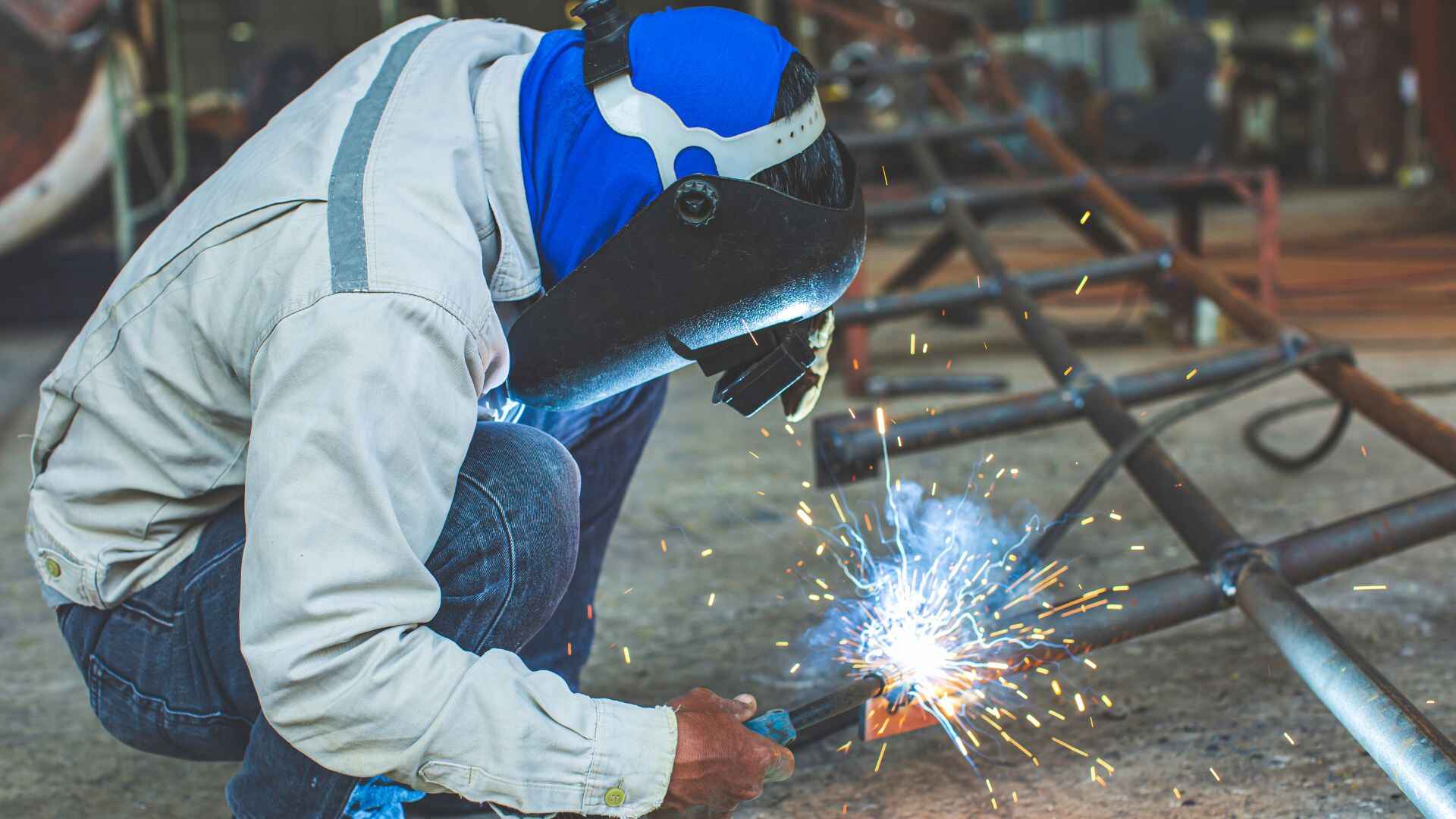
Welding is a technical skill which is one of the most in-demand skills in Nepal and worldwide. It has a wide range of working industries, such as construction sites, hydropower projects, automobile workshops, and manufacturing. Welding is the process of joining metals and building strong structures. It is not just a skill; it is the transformation of your skills into career opportunities in Nepal and abroad for many youths.
If you are wondering how to acquire welding training in Nepal, first, you need to understand the different types of welding and their use cases. In this blog, we will discuss types of welding, career opportunities, and how you can choose the right training course based on your career goals.
What is welding?
This is the method of joining materials like metals, steels, and even thermoplastics by using heat, pressure, or both. It creates a permanent and strong bond.
It's commonly seen in Nepal, including:
• Projects like buildings, bridges and hydropower constructions.
• Workshops on automobiles and motorcycles.
• Metal fabrication shops.
• Industrial machinery and pipelines.
Why is welding an important skill in Nepal?
Every year in Nepal, the demand for welders is increasing in numbers. As Nepal is a developing country, Nepal has ongoing infrastructure development, hydropower projects, and the automobile sectors require trained welders. Having welding skills will increase the job potential for Nepalese in Gulf countries, Japan, Korea and even in Europe and offer attractive salaries.
After completing the welding training course in Nepal, you will be able to:
• You can work in local industries, workshops, and projects.
• It will open the door to apply for welding jobs abroad with higher income opportunities.
• Start a business of fabrication or workshop.
Types of welding and their uses.
Here are the most common types of welding methods, and their uses
1. Shielded Metal Arc Welding (SMAW / Stick Welding)
This is one of the oldest and most widely used welding methods. It uses an electrode coated in flux to weld metals.
Uses:
• It is used in buildings and bridges.
• Pipelines and machinery’s repair and maintenance.
• Outdoor welding where portability is needed.
Training Level: Fundamentals of Welding
Many training institutes in Nepal start with SMAW because it is simple and cost-effective.
2. Gas Metal Arc Welding (GMAW / MIG Welding)
It is the process of welding by using a continuous wire electrode and shielding gas. It builds clean and efficient welds.
Uses:
• Automobile industry (car body repairs, fabrication).
• Sheet metal and light construction projects.
• Manufacturing workshops.
Training Level: Intermediate.
MIG is advanced than SMAW, and it requires more practice but is highly valuable in workshops.
3. Gas Tungsten Arc Welding (GTAW / TIG Welding)
TIG welding is a precise welding technique that uses a non-consumable tungsten electrode and inert gas.
Uses:
• Welding stainless steel, aluminum, and other non-ferrous metals.
• Hydropower projects, pipelines, and food industry equipment.
• Aerospace and high-precision industries.
Training Level: Advanced. TIG welding needs more control and skill, making it a valuable career skill for overseas jobs.
4. Flux-Cored Arc Welding (FCAW)
This is a similar method to MIG welding; however, it uses a flux-filled wire. It doesn’t need external shielding gas, which is more reliable and practical for outdoor welding.
Uses:
• Heavy equipment manufacturing.
• Industrial construction projects.
• Outdoor welding where the wind makes MIG difficult.
Training Level: Intermediate.
This is the right choice for learners aiming to work in large industries.
5. Oxy-Acetylene Welding (Gas Welding)
This is a traditional welding technique that uses a flame of oxygen and acetylene gas. This is commonly used today in small workshops.
Uses:
• Repairing old machinery.
• Cutting and brazing metals.
• Workshop-level metal repairs in rural areas of Nepal.
Training Level: Beginner.
Often taught in training institutes as a base skill.
6. Plasma Arc Welding (PAW) (Advanced)
This welding is a high-tech method like TIG welding; the difference is that Plasma Arc is used for more precision.
Uses:
• Aerospace and defense industries.
• High-quality, small, and precise welds.
Training Level: Advanced. Rare in Nepal, but useful knowledge for students planning to work abroad.
Choosing the Right Welding Training in Nepal
Before joining a welding training institute in Nepal, you should consider the following:
• Hands-on practice: Check the course syllabus that provides practical training, not just fundamentals.
• Safety training: See the workshop that ensures safety protection
• Certification: Certifications like CTEVT or ISO will make you help you get a job in Nepal and abroad.
• Trainer experience: An expert trainer will help you learn in a better way.
Conclusion
Welding is a skill that builds the backbone of industries. From simple stick welding to advanced TIG and plasma welding, each type has its unique applications. For Nepalese youths, learning welding through proper training can open doors to secure local employment and high-paying jobs abroad.
If you are looking to build your skills in welding training in Nepal, you can explore our Welding Training in Nepal

How to Plan and Install Industrial Wiring
A Complete Guide for Beginners
Industrial wiring plays an important role in strengthening factories, workshops, and large-scale facilities. Unlike domestic wires, industrial electrical systems are more complex, as they handle heavy machinery, high voltage, and continuous operation. Planning and establishing industrial wiring is an essential skill for electricians, technicians, and engineering students who want to create a professional career in this field. In this guide, we will run you through the major stages of planning and installing industrial wiring.
In this guide, we will walk you through the key steps of planning and installing industrial wiring.
1. Introduction to Industrial Wiring
Industrial wiring is the process of installing electrical circuits and systems in manufacturing plants, factories, or large commercial places. This includes the correct cable, protective equipment, selecting distribution boards, and ensuring safety compliance.
Key differences from domestic wiring:
• Handles high voltage and current.
• Strong insulation and large cable shapes are required.
• Advanced security systems (circuit breakers, relays, and earthing) are included.
• Industrial safety codes and standards should be followed.
2. Planning the Wiring Layout
The proper plan ensures safety, efficiency, and cost-effectiveness.
Steps in Plan:
Understand the requirement of electricity—calculate the total load of machines and equipment.
• Site Survey Identify places for the switchboard, machine, lighting, and emergency systems.
• Choose a wiring system—Decide whether to use surface wiring, conduit wiring, or cable tray.
• Create a wiring diagram Use a single-line diagram and circuit layout for secrecy.
• Ensure compliance - follow local electric codes and industrial standards.
3. Tools and Materials Required
Before installation, prepare the right tools and materials.
• Tools: Wire stripper, pliers, tester, multimeter, drilling machine, conduit bender.
• Materials: Industrial cables, conduits, junction boxes, circuit breakers, distribution panels, switches, sockets, and earthing rods.
4. Installation Process Step-by-Step
Step 1: Marking and Layout
• Mark positions for machines, switchboards, and panels.
• Install a conduit or cable tray along the layout path.
Step 2: Wiring and Connections
• Pull the wires through the conduits/cable tray.
• Connect wires to switches, sockets, and distribution boards.
• Label wire for identification.
Step 3: Earthing and Grounding
• Install proper earthing to avoid electric shock.
• Use copper plates, earthing rods, or chemical earthing systems.
Step 4: Installing Protective Devices
• Fix circuit breakers, MCBs, MCCBs, and fuses.
• Ensure proper ratings for each device according to load.
Step 5: Testing and Commissioning
Check continuity, insulation resistance, and polarity.
• Test with a multimeter before activating the system.
• Run trial operation to ensure smooth functioning.
5. Safety Precautions in Industrial Wiring
Safety should always be the priority.
• Never work on live wires.
• Always wear insulating gloves and safety gear.
• Use proper earthing to prevent electric shocks.
• Avoid overloading circuits.
• Follow government and industrial electrical codes.
6. Career opportunities in industrial wires
Learning industrial wiring opens many opportunities in Nepal and abroad.
• Jobs in factories and industries—as an electrician or technician.
• Construction Projects—Industrial Sites, Commercial Complexes.
• Employment abroad—demand in Gulf countries, Malaysia, and other areas.
• Entrepreneurship - starting your own electrical service business.
Final thoughts
Industrial wiring is not only about adding wires—it is about ensuring safe and reliable power distribution in large features. With proper training, equipment, and safety measures, one can master the process of planning and installing industrial wiring. If you want to know more about the industrial wiring, you can check our classes course of Industrial Wiring Training
If you are looking to make a career in the electric field, enrolling in a professional industrial wiring training program can help you get skills, certification, and job opportunities in Nepal and abroad.

Latest automobile technologies in 2026
A guide for students and trainees
The automotive industry is increasingly utilizing new techniques that make vehicles smarter, safer, and more efficient. In 2025, cars are no longer just machines for transportation; they are advanced systems that combine electronics, artificial intelligence, renewable energy, and smart connectivity.
For students, mechanics, and training seekers, understanding these techniques is important to create a strong career in the motor vehicle field. This guide highlights the latest automobile technologies and training and future job opportunities in 2025.
1. Introduction to modern automobile technologies
Traditional mechanical systems are being replaced or extended by digital, electric, and smart innovations. Today's vehicles include advanced electronics, AI-powered software, and environmentally friendly solutions.
Why students should learn this:
• Increases job opportunities in Nepal and abroad.
• Preparations for the future automobile workshops prepared for the future.
• Creates practical skills in both repair and innovation.
2. Key Automobile Technologies in 2025
2.1 Electric Vehicles (EVS)
• EVs are mainstream with better battery performance and charging infrastructure.
• EV maintenance and training in battery management and charging systems are in excessive demand.
2.2 hybrid vehicle
• Hybrid cars combine fuel engines with electric motors.
• Trainees should learn dual power system troubleshooting and fuel efficiency optimization.
2.3 Autonomous Driving Car)
• Cars use AI, cameras, sensors, and radar to drive with minimal human input.
• Skills, AI diagnostics, and software updates are required in sensors.
2.4 Advanced Driver Assistance System (ADAS)
• Lane Assist, automatic braking, parking sensor, and blind-spot detection.
• The training focuses on calibrating the sensor and maintaining the ADAS module.
2.5 connected cars (IOT integration)
• Cars are now connected to the Internet for navigation, remote monitoring, and real-time updates.
• Knowledge of clinical software and IOT systems is becoming important.
2.6 Hydrogen Fuel Cell Vehicle
• Uses hydrogen in the form of fuel and only produces water vapour as an exit.
• Training includes fuel cell stack maintenance and hydrogen safety protocols.
2.7 Smart Infotainment System
• Vehicles have advanced dashboards, touchscreens, and voice-controlled features.
• Students should learn the integration of infotainment with vehicle electronics.
2.8 permanent materials and light design
• To improve automakers' efficiency, use environmentally friendly, recycled, and light materials.
• Training involves understanding modern motor vehicle manufacturing processes.
3. Modern automobile technology requires tools and skills to learn
• Diagnostic scanners and software tools—for EVs and connected cars.
• Battery analyst and charging equipment—for EV maintenance.
• Calibrate sensor equipment—for ADAS and autonomous systems.
• Programming basics (AI & IOT)—to understand the digital vehicle system.
• Mechanical and electrical skills are still important for hybrids and traditional systems.
4. Security precautions in automobile technology training
• Always disconnect the battery before working on EVS.
• Use untouched tools when handling the high-voltage system.
• Follow proper hydrogen storage and handling security for fuel cell vehicles.
• Wear protective gear (gloves, glasses, shoes) while working on workshops.
5. Career opportunities in automobile technology
By learning these latest techniques, students can get opportunities:
• EV workshops and service centers
• International Motor Vehicle Industry
• Car construction companies
• Transport and Logistics Firm
• Entrepreneurship—opening an EV charging station or repair center
final thoughts
The automobile industry is shaping the future of mobility in 2025. There are many advanced technology vehicles, such as electric, hybrid, and self-driving and connected systems, that need skilled technicians. To manage smooth automobile maintenance, we need expert technicians who understand both mechanics and modern electronics.
If you want to stay ahead in this field, enrolling in a professional automobile training program will give you knowledge, certification and better career opportunities in Nepal and abroad. For more details, explore our automobile training in Nepal.

Top Tools Every Motorbike Mechanic Need
A Guide for Students & Trainees
Motorbike mechanic is one of the highly demanded technical skills in Nepal and internationally. It includes the daily commuters to delivery services; everyone uses motorcycles, and skilled mechanics are always required. A successful mechanic requires the right set of tools along with technical knowledge.
For those who are looking to build a career in motorcycle mechanics, understanding the use of the right tools is the first step towards becoming skilled motorcycle mechanics.
What is motorbike mechanics?
This is the process of using a variety of hand tools, power tools, and diagnostic equipment to repair, maintain, and modify or upgrade two-wheelers. Every tool has a unique purpose, and understanding the right way to use the tools ensures proper, safe, fast, and professional work.
Whether you want to work in a garage, open your workshop, or go abroad for employment, mastering these tools is a must.
Essential Tools Every Motorbike Mechanic Needs
1. basic hand equipment
These are the foundations of any mechanic's toolkit:
• Wrench and spanner (open, ring, adjustable) - to tighten and loosen the nuts and bolts.
• socket sets and shafts - make engines and wheels easier.
• Screws (Flathed and Philips) - for electrical and mechanical fittings.
• Sarauta (cutting, nose, locking) - for catching, cutting and bending wires or parts.
• Alan keys (hex keys) - usually used in modern motorbikes for engine and body fittings.
2. special motorbike equipment
• Torque wrench - ensures that the bolt is tightened to the manufacturer's specification.
• Chain breakers and reversing tools - to remove and install motorcycle chains.
• Tire lever and bead breakers - help in tire removal and replacement.
• Clutch holding tool - used during clutch servicing.
• Filer gauge - to measure spark plug interval and valve clearance.
3. Electrical and Clinical Equipment
• Multimeter - Battery, wiring and electrical systems are required for testing.
• Spark plug examiner - quickly examines ignition performance.
• OBD (on-board diagnostics) is used in modern bikes to detect scanner-turty code.
4. workshop power equipment
• Air compressor - to inflate tires and use pneumatic devices.
• Effect wrench - makes it easier to remove hard nuts (such as wheel or engine bolt).
• Bench Grinder and Drill Machine - to shape, grind or drill metal parts.
5. security equipment
• Protective gloves - stop cuts and irritation.
• Security glasses - protect the eyes while grinding or cutting.
• Apron and shoes - Protect the mechanic from oil, sparks and heavy equipment.
Why learning tools are important in training
• Confidence in handling different types of repairs.
• Ensures accuracy and professionalism in servicing.
• Reduces the risk of accidents and mistakes.
• Prepare students for real-world workshops in Nepal and abroad.
Career opportunities for trained motorcycle mechanics
With proper training and equipment knowledge, you can work in:
• Local workshops and service centers
• Motorbike Dealership
• International Automobile Workshops (Gulf, Malaysia, Japan, etc.)
• Offer self -garage or business - offer repair and modification services
final thoughts
A motorbike without equipment is like a doctor without mechanical medical devices. By learning top equipment and its applications, students can become skilled professionals ready for the increasing demand in the motorcycle repair industry.
If you are willing to build your career in motorbike training, explore our motorbike mechanic training in Nepal.

AC Technician Salary in Nepal: How Much Can You Earn After Vocational Training?
If you are thinking about considering a career as an AC and refrigerator technician in Nepal, one of the first question which might come to your mind can be: how much I will be able to earn?
The good news is that skilled AC technicians are extremely in demand, not just in Kathmandu, but across the Nepal and in Gulf countries like UAE, Saudi Arabia, Qatar, Malaysia, and so on. And with the right guidance and proper training, you will be able to earn a good income within the months.
In this article, we will break down the realistic salary and earnings figures for the AC technicians at different career stages in Nepal, so it’ll be helpful for you to make decisions about your future.
Why are AC technicians' skills in high demand in Nepal?
As Nepal's climate is changing. Summer is getting hotter and growing, and unplanned urbanization leads to the rise of pollution, and the rise of middle-class household income means air conditioner sales are increasing every year. According to the latest industry estimates, thousands of AC units are being sold and installed in major cities like Kathmandu, Pokhara, Biratnagar, and Nepalgunj each year, and every single one that has been installed needs technicians to install, service, and repair it.
As a result, there are currently more job openings than there are qualified technicians available to fill the quota, making this one of the best vocational careers to get started right now.
AC Technician Salary in Nepal: A Breakdown by Career Stage
|
Career Stage |
Monthly Salary (NPR) |
Monthly Salary (USD) |
|
Fresher (0–1 year) |
NPR 18,000 – 25,000 |
USD 135 – 190 |
|
Experienced (2–4 years) |
NPR 28,000 – 45,000 |
USD 210 – 340 |
|
Senior Technician (5+ years) |
NPR 50,000 – 80,000 |
USD 375 – 600 |
|
Freelance Technician |
NPR 40,000 – 1,20,000+ |
USD 300 – 900+ |
|
Gulf Employment (Qatar/UAE) |
NPR 60,000 – 1,30,000 |
USD 450 – 975 |
Note: Figures are estimates based on market data as of 2025.
1. Fresher Salary: What to Expect in Your First Job
If you are just starting out after your vocational training course, you can realistically expect to get a salary from 18,000 to 25,000 per month. Most freshers join as junior technicians or helper technicians at HVAC companies, electric firms, or appliance service centers.
As in the first year, you will be able to gain in-hand experience and be able to build your experience and confidence. Many technicians see their in-hand jobs get a pay raise to NPR 25,000-30,000 without changing their current job. Employers in Nepal’s HVAC sector are known to reward performance quickly because skilled workers are hard to find it nowadays.
2. Experienced Technician Salary (2-4 Years)
After getting experience of two to four years in the field, a skilled technician in Nepal can earn typically from NPR 28,000 to 45,000 per month. At this stage, many technicians are capable of handling the installation jobs independently without any help, can supervise junior workers, and are able to take on more complex diagnostic work.
Technicians who specialize in inverter AC systems, VRF systems, or commercial cold room installations are able to earn a high-end salary and sometimes beyond it.
3. Senior Technician and Team Leader Level
Senior technicians with five or more than five years of experience is able to do troubleshooting and can earn NPR 50,000 to NPR 80,000 per month. Those who move into the team leader or at the supervisor role may even more.
At this stage, many senior technicians also take on private contracts on the side, significantly boosting their total monthly income.
4. Freelance Earnings: The Real Income Potential
Many experienced AC technicians in Nepal choose to do full-time freelancing aside from their regular job as their primary income. The earnings given below are significantly higher:
- A standard AC service and cleaning typically earn NPR 1,500–2,000 per unit
- AC installation earns NPR 3,000–6,000 per unit depending on the AC type
- Gas recharge jobs typically earn NPR 2,000–4,000 per AC unit
- Refrigerator repairs earn NPR 1,500–3,000 per job
A freelance technician doing just 3-4 jobs per day can earn from NPR 6,000 to 10,000 per day during the peak summer months. Many well-known and established freelancers in Kathmandu can earn from 80,000 to 1,50,000 per month during the season.
5. Foreign Employment: The Gulf Opportunity
One of the best ways for trained AC technicians from Nepal to make money is to work abroad, especially in Qatar, the UAE, Saudi Arabia, and Kuwait.
HVAC technicians in these countries usually make tax-free salaries of NPR 60,000 to 1,30,000 per month. The employer usually pays for their housing and food. This is why many vocational training graduates in Nepal want to work in technical fields abroad.
To be able to work as an AC technician in another country, you usually need the following:
- A certificate of vocational training that is recognized (CTEVT-affiliated)
- At least one to two years of real-world experience
- A passport that is still valid and a medical clearance that is still valid
- Foreign Employment Board (FEB) registration through an authorized manpower agency
How can you Maximize Your Earning as an AC Technician?
- Get certified training: A CTEVT-affiliated certificate from a recognized institute, such as Apex Skills Academy, gives you credibility with employers and clients.
- Specialize: Get good at inverter AC technology, VRF systems, and commercial refrigeration. Specialized skills can be costly.
- Build a client base: In Nepal, word of mouth is powerful. Every happy customer can send you new business.
- Consider working in the Gulf: Even two to three years of work there can change your financial situation. Many technicians who come back use their savings to start their own HVAC business.
- Keep learning: New AC technologies, such as smart ACs and solar-powered systems, are growing. Staying updated keeps you ahead of the competition.
Start Your AC Technician Career with Apex Skills Academy
At Apex Skills Academy, we have trained hundreds of AC and refrigeration technicians who are now successfully employed across Nepal and abroad. Our 3-month hands-on course gives you the practical skills, CTEVT-affiliated certificate, and career support you need to start earning immediately. You can check out AC and Refrigeration Training to get enrolled if you are interested in it.
New batches start every month. Seats are limited.
Ready to start? Contact Apex Skills Academy today.

Why Every App and Website You Use Has a QA Tester Behind It And Why That Job Matters
When you are hungry at midnight and try to order the food, but the order place button isn’t showing, or when you open your banking app to transfer money…… and it crashes. It’s frustrating, right?
This issue or glitch rarely happens by accident. Behind every app and website you use on a daily basis, there is a dedicated QA tester present to make sure there won’t be any glitches, hunt bugs, provide stress-test features, and ensure that the digital world does not fall apart.
In the context of 2026, with AI-generated code that is flooding the system and user expectations that are getting higher than ever before, the role of QA tester has never been more serious. They help to prevent disasters, which cost around billions, and protect your valuable time, data, and trust.
Here’s the reason why this job matters more than people realize.
What does a QA tester actually do?
A QA (Quality Assurance) tester is the person who is responsible for software working as intended, performing well under real-world conditions, and delivering a great user experience.
Daily responsibilities of a QA tester typically include:
- To write and execute the test case (detailed scenarios to check each and every feature).
- Help to perform manual testing for usability, edge cases, and user intentions.
- Build and run automated tests using tools like Selenium, Cypress, or Appium.
- Conducts regression testing to ensure the new changes don’t break old features.
- Reporting bugs clearly in tools like Jira, with steps to reproduce, severity, and screenshots.
- Testing for security vulnerabilities, accessibility (e.g., WCAG compliance), performance underload, and cross-device compatibility.
Some major key skills, sharp attention to detail, analytical thinking, basic programming knowledge, and understanding of user psychology.
How QA testers are embedded in every app and website you use
The modern software development cycle follows the SDLC (Software Development Life Cycle), but often in Agile or DevOps environments. QA isn’t an afterthought anymore. Testing starts early in requirements and design phases.
Each app needs QA. One minor overlooked bug can totally destroy the user trust; studies show that more than 85% of users abandon the site when they feel a bad experience.
From your daily use of apps to complex enterprise platforms, QA testers ensure:
- Its features work on iOS, Android, web, and edge devices.
- The apps handle thousands of users simultaneously without crashing.
- The minor security threats do not expose your personal data.
Without them, the experience you take for granted simply wouldn’t exist.
Why does QA testing matter?
Poor software quality isn’t cheap. According to the CISQ (Consortium for Information & Software Quality), the cost of poor software quality in the US alone reached at least 2.41 trillion.
Which includes technical debt around ($1.52 trillion), lost productivity, security incidents, and the post-release fixes.
Think of the Rule of 100 not as a spreadsheet formula but as a "stress scale." In the world of tech, money is often just a proxy for human time, sleep, and sanity.
When we look at these massive failures, we usually see them as "corporate disasters" or "financial data points." But inside the offices where these happened, they weren't just numbers; they were moments of pure, cold-sweat-inducing human panic.
Here is what these legendary glitches felt like for the people standing in the room:
1. Knight Capital (2012): The Ghost in the Machine
The Legend: A $440 million loss in 45 minutes.
The Human Reality: Imagine arriving at the office on a sunny Wednesday morning, coffee in hand, ready for a standard day of trading. You look at your screen and realize that your company is "bleeding" money at a rate of $10 million per minute.
For 45 minutes, engineers and traders stood frozen, frantically trying to locate the "kill switch" for a rogue algorithm they didn't realize was active. It wasn't just a "software glitch"; it was the sound of a 20-year-old company’s heart stopping in real-time. By lunch, the firm was effectively bankrupt. It’s the ultimate nightmare of losing control to a machine you built but can no longer talk to.
2. Toyota: The Betrayal of “Safe Space"
The Legend: $1.2 billion in settlements for unintended acceleration.
The Human Reality: This isn't about "recalls"; it’s about the terrifying moment when a father or mother realizes the car carrying their children isn't listening to them anymore.
For the engineers at Toyota, the "cost" wasn't just the billion-dollar fine; it was the crushing weight of knowing that their code the lines they typed into a computer in a quiet office was physically present in a family's panic on a highway. It turned a vehicle, which is supposed to be a symbol of freedom and safety, into a source of helplessness. That is a heavy burden for any developer to carry home at night.
3. NASA Mariner 1 (1962): The Weight of a Single Keystroke
The Legend: A missing hyphen caused a rocket to self-destruct.
The Human Reality: We have all sent an email with a typo. Usually, the "cost" is a bit of embarrassment. But for the programmer of Mariner 1, that "typo" (a missing overbar/hyphen in the guidance logic) which resulted in years of collective human effort thousands of hours of math, sweat, and dreams turning into a $18.5 million firework over the Atlantic Ocean just 293 seconds after launch.
Imagine being the person who realized it was your finger that missed that one key. The silence in the control room wasn't just about the money; it was the heartbreak of a "perfect" mission being brought down by the most relatable, tiny human mistake imaginable.
Why the QA Tester Job Still Matters in the AI Era
AI is helping with QA transformation, which is a good thing. Almost each and every team uses AI for generating test cases, creating synthetic data, and self-healing scripts.
Think of AI as a high-tech metal detector: it’s brilliant at finding the nails you dropped, but it has no clue if the house you're building is a place someone would want to live in. While a bot can confirm a "Submit" button technically works in 0.02 seconds, it can’t tell you that the button is annoyingly small or that the popup is frustrating enough to make a user want to toss their phone across the room. AI handles the "Did it break?" math, but humans provide the "Does it suck?" intuition.
In an era of automated logic, the QA tester is the soul in the machine, the one who ensures technology serves people, not just protocols. Although there are several challenges QA teams face in today’s context:
- The tight deadlines and the pressures to “just ship it”.
- There may be repetitive work (mitigated by automation).
- It's to blame when the bugs slip through despite the incomplete requirements.
Despite this, the job is evolving into high-value roles like quality engineer or software development engineer in test (SDET). The demand remains strong as software complexity explodes.
QA testers are one of the invisible reasons that digital worlds can operate smoothly. They help big companies to save trillions in potential losses and protect the user from frustration and risks, enabling innovation to move fast without breaking things.
In 2026 and beyond, their job isn’t disappearing, it is becoming more strategic, more technical and essential. The next time you enjoy a bug free experience, silently thank the QA team behind it.

Skill Course for Pathao & inDrive Drivers in Nepal — Flat 35% Off at Apex Skills Academy
The monthly income, which comes from the ride-sharing app after the fuel and platform fees, varies in the 20,000-30,000 range in most of the months. It is not bad when you have started it, but the number looks almost the same each and every year and before that.
It is not your fault; the platform is designed to act as a ceiling. You can ride for more than hours, but you can’t negotiate a better fare. The income flow does not change that much because you work harder.
At Apex Skill Academy we offer you a skill course for all the ride-sharing drivers, which can change your income math entirely. We are offering up to 35% discount offers on all trade and technical skill programs. The skill training you get from us will be ISO-certified and practical, and the courses will be wrapped up within 4-6 weeks.
5 Apex Courses That Works for Drivers
All the courses available at Apex Skill Academy are technical and skill programs. All are ISO 9001:2015 certified. All that can be completed alongside your driving income.
1. AC and Refrigerator Training in Nepal
In every summer, AC technicians in Kathmandu are almost booked fully and solid. People have to wait for weeks for them to get their AC repaired. Outside the valley, the wait is even longer because the technicians are also fewer. This is not any kind of trend that is reversing. In the context of Nepal, the number of people putting in air conditioning is increasing every year.
Apex’s AC and refrigeration course covers installation, repair, and full maintenance. You will spend your time with us on real units, not on the diagram. The income you will be able to generate from being a self-employed AC worker can exceed your ride-sharing income in a higher ratio within a few months after completing our work.
Do check out our AC and refrigerator training to get to know about it in detail.
2. Home Appliance Repair Training in Nepal
In this skill course you will learn to fix every household appliance. When the washing machine breaks, the refrigerator stops working, or the water heater dies in the middle of the winter, most people do not have anyone reliable to call, and it is where your skill will shine.
A home appliance technician will fix things properly and get called back every time. The whole idea behind learning this skill is to be reliable and skilled. In any district, the client base you can build within the months can be huge.
At Apex, home appliance repair training is 1.5 months of practical instruction. You will get training in fault diagnosis, component replacement, and safety handling. You can start taking weekend jobs before the course even ends.
You can check the full details about it on our course Home Appliances Repair Training in full detail.
3. Electronics Troubleshooting Training in Nepal
When some electronic items break in your house—a TV, an inverter, or a power supply you use in your house—do you throw it, or do you want to know what happened?
If your instinct tells you the second is correct, this course will fit you fully.
The Apex electronic troubleshooting course covers all the circuit diagnosis, component-level repair, and device testing over 4-6 weeks. These skills will apply to TVs, audio systems, inverters, power supplies, and the growing range of electronics that are now standard in Nepali homes and offices.
The devices that are too expensive to replace go to the person who will fix them. That person can earn well and does not shop to build the clientele.
For more info, you can check Electronics Troubleshooting Training for detailed analysis.
4. Motor Rewinding Training in Nepal
The water pumps, fans, and agricultural equipment that run on the electric motors will fail eventually. When that happens, most people do not know or have no idea how to fix them. Outside of Kathmandu, there are very few motor rewinders who can fix them and make them work.
Low competition in the market means higher demand for the work, which will give you the upper hand to set the price. This can be a huge thing.
The Apex Motor Rewinding Course covers AC/DC motor repair, winding, and fault diagnosis in 1.5-2 months of practical training. The course, which nobody talks about, is part of what makes it worth taking.
If you want to get enrolled or to know about this course more, do check out the Motor Rewinding Training course at Apex Skills Academy for more information.
5. Motorbike Mechanic Training in Nepal
Most Pathao, InDrive, and Yangoo drivers know their bikes better than most people who have never ridden one. You can feel when something is off. You have done your maintenance. You know what things cost and how they should feel when they are working.
At Apex’s motorbike mechanic training, an upcoming class will help you build an additional skill, which is already familiar to your profession. Full maintenance training alongside the repair and diagnosis can help you a lot. This is the course that you know already a little bit, which will make you more skillful and put a certificate behind it.
Register early to secure your seat. The upcoming class will open shortly after the batches are full.
You can get full descriptions of this at Motorbike Mechanic Training — Apex Skills Academy.
If you are interested in any of these hard skills trainings and want to enroll:
1. Go to apexskillsacademy.com and pick your course
2. Fill out the enrollment enquiry form
3. The Apex team confirms your enrollment at the discounted rate
Apply to every technical and trade course on the platform. No minimum, no restrictions.
2 free trial classes before you pay anything. Try it first.
Chabahil 07, Gopikrishna / New Baneshor, Suruchi Marga, Kathmandu ✉️ apexskillsacademy@gmail.com

Nepal Army Skill Course -35% off at Technical Training at Apex Skills Academy.
You gave years to this country. Before anybody was up. The long postings are homesick. Labor under circumstances that most people would flee. You did it; you did it right.
But service ends. The uniform is unzipped. The pension is good, but it has its limits, most of the time only felt when out of service. The next thing is the actual question, and to many Nepal Army men, the response is a trade skill.
Not a degree. Not years spent in a classroom. An applied, trained competence that brings hard cash in the actual world can be utilized whether you remain in Kathmandu or go back to your home district.
Apex Skills Academy is doing just that as of now. All Nepal Army skill courses that are available on their platform are discounted by 35% for active and retired army members. Nearly all courses are fully practical and ISO 9001:2015 certified and complete in only 1.5 months.
Why These Skills Are a Natural Fit.
The trend that is present is the success following retirement of soldiers. The desk jobs are not sought after by them. They go out to seek employment in which there is no middle ground, whether the job is done well or it is not. No grey areas. No conferences concerning conferences. Righteousness is a real problem.
This is the way trade work works.
Wiring in electrical, welding, AC repairs, and rewinding motors—these skills pay attention to detail. You do things the correct way, revise what you do, and do not take shortcuts, as it will reflect in the outcome. The army conditioned you to work in that very manner. You already know how to go through a process when under pressure. You can already guess what it is to appear without being pursued. Trade courses do not teach you such things. It simply provides them with another location to visit.
The 5 courses that are the most sensible at Apex.
Each of the five courses listed below is a certification course by ISO 9001:2015, is based on practical work as opposed to theory, and is completed in only 1.5 months.
• House Wiring Training
Any new house, store, office, and school require good electrical jobs. There are trained wiring professionals in most of the towns other than Kathmandu, and they are rarely available and are always busy. The house wiring course at Apex includes circuit design, safe electrical installation, and actual wiring of a setup. It is novice-oriented yet is speedy. This takes a short time to pick up by the people who already think in steps and sequences, which army training develops automatically.
This is a skill that pays off on the first job and that you will find useful in the home district when the soldiers have served. Good electricians are called back, and the information spreads like wildfire in small towns. The monthly salary of a trained Nepalese electrician ranges from NPR 30,000 to 55,000, and independent workers with a loyal client base earn more. You can know about this course in House Wiring Training in Nepal
• Industrial Wiring Training
Electrical systems are used in factories, warehouses, processing plants, and even large government buildings and require experienced technicians to install and maintain them. These positions are better paid and are on longer contracts than most residential ones. The industrial wiring course offered by Apex includes panel wiring, motor control circuits, three-phase systems, and industrial safety measures. This is the straight line to a contractor or technical lead position to retired officers or senior NCOs seeking to take that step. Monthly earnings are between NPR 40,000 and 75,000, and those who have their own contracting businesses earn more. For more information and a detailed explanation about this course, do check out Industrial Wiring Training
• Refrigeration and AC Training.
Each and every year, Nepal is equipping more homes, offices, hospitals, and hotels with air conditioning, which is not being matched by the trained technicians to service the units. The AC repair shops in Kathmandu are overbooked every summer. Beyond the valley, things are even worse: there are fewer technicians and as many units requiring services.
The AC and refrigeration course at Apex includes installation, complete repair, and maintenance. The 1.5 months are mostly working on actual units, so by the end of it, the job is not unfamiliar to you; dozens of times you have done that job in training. An AC technician who is self-employed in Nepal makes NPR 40,000-70,000 in a month, and the demand is higher during the summer vacation. This course is always among the highest-ranking courses among army personnel aiming to have a quick route to independent income. You can also know about this course on AC and Refrigeration Training in Nepal
• Welding Training: MIG, TIG, and Arc.
The construction industry, fabrication shops, vehicle repair businesses, and infrastructure development of Nepal require skilled welders, and it is not expected to reduce at any speed. Apex is the only school that offers all three welding techniques, MIG, TIG, and arc, in one 1.5-month course. Knowing three ways implies a variety of kinds of jobs you can do and more freedom in the market. Welding is one of the hot and demanded skills in the market. With our training course, you will be able to earn a sufficient amount of money through this skill.
To soldiers in the engineering or logistics units, a lot of this information will already be known. The course renders it official. You walk away with a certification to employers and clients indicating precisely what you are able to do. The monthly salaries of a trained welder in Nepal range between NPR 35,000 and 65,000, and specialists in fabrication or pipeline construction have higher salaries. For more information about this topic, visit Professional Welding Training
• Motor Rewinding Training
Most people are not even aware of what to do when an electric motor malfunctions in a water pump, a fan, or farm machinery. A rewinder motor does. In most districts, Kathmandu does not have a trained motor rewinding specialist. The individual that appears and solves the issue is called back each and every time, and, in most fields, there is hardly any competition. The work is directly impacted by that scarcity in terms of what it pays.
The motor rewinding course of Apex includes AC and DC motor repair, winding methods, and fault diagnosis during 1.5 months of practical work. For army personnel who have a mechanical or engineering background, the technical is easy. The formal certification that you are getting is supporting it. The monthly earnings range between NPR 35,000 and 60,000, and in localities where there are no competitors, the rates go high. Taking your discount is two minutes. Go to apexskillsacademy.com, select the course that suits your interests, and complete the enrollment form. The Apex team will charge your discount and then check your spot. Not only active soldiers but also retired soldiers: no paperwork or evidence is needed. If you want to know more about this training course, check out our Motor Rewinding Training Course.
Service demands a lot and is returned in a not very noticeable manner at times. The discipline, the follow-through, and the skill to plod through something tough without turning it dramatic—these last. They only require a new course.
The Apex Skills Academy has the right direction in the form of a technical trade course. ISO certified.
The Chabahil and Baneswor skill centers, both in Kathmandu, conduct physical classes. You can inquire about online options when filling in the form, in case you are stationed or living out of the valley. Apex also has 2 free trial classes prior to committing to anything: sit through an actual training, meet your instructor, and make the decision with no payment necessary.
Location: Chabahil 07 Gopikrishna, New Baneshor, Suruchi Marga, Kathmandu
Website Info: info@apexskillsacademy.com

Return from Gulf & Save 40% on Skill Training Courses in Kathmandu
You were toiling overseas. Time to invest in yourself now.
You have only come back to a gulf country; there is something big in Apex Skills Academy. Use your Gulf visa and receive a 40% discount on any hard skill course in Kathmandu.
The Reason This Offer Exists.
Nepalis work years in Qatar, the UAE, Saudi Arabia, Kuwait, and Oman. They remit money. They support families. They frequently re-emerge, however, without a home skill or a qualification.
That complicates getting decent employment in Nepal.
This offer tries to fix that.
Hard Skills at Apex Skills Academy.
These are trade courses you study by hand. Employers can test your skill. It will be paid by clients.
1. House Wiring Training
No home can do without an electrician. The course will educate you on the process of installing and connecting wires in apartments and homes without any problems. You are taught how to design a circuit, fit a switchboard, and follow regulations on safety. You will be able to work with builders or independently after this course.
2. Industrial Wiring (1.5 Months) Training.
This is the second stage of electric work. You get to know how wiring is done in factories, workshops, and large buildings. The course includes motors, control panels, and three-phase power lines. This is a highly sought skill in Kathmandu and beyond.
3. Motor Rewinding Training (1.5 Months)
Pumps, fans, and machines have motors within them. When they break, someone has to repair them. This course will teach you to rewind AC and DC motors and locate faults as well as repair them. It is one of the skills that not many people possess, which leads to a stable job and decent income.
4. AC and Refrigeration Training (1.5 Months)
Every home and office has an air conditioner and a fridge. This course will teach you how to install, maintain, and repair them. You are familiar with gas refilling, compressor maintenance, and electrical faults. AC technicians are busy all year round. 5. Home Appliances Repair Training (1.5 Months)
Microwaves, washing machines, water heaters, and irons. They disintegrate all. This course will show you how to repair them. You get to know how to locate the fault, change the part, and test the fix. You can work at a repair shop or provide your own service at home.
6. E-Electronics Troubleshooting Training (1.5 Months)
TV sets, radios, amplifiers, and circuit boards require repair, as well. This course will teach you how to read circuits, how to use testing equipment, and how to correct electronic faults. The ability to work with small parts and to solve problems is a great skill.
7. Welding: MIG, TIG, and Arc (1.5 months)
Construction, gates, furniture, and factories require welding. Three forms of welding (MIG, TIG, and arc) are discussed in this course. You train on actual metal initially. Well-trained welders can make good money both in Nepal and in other countries.
8. Plumbing Training (1.5 Months)
A plumber is required in every building. This course will teach you the installation and repair of water pipes, taps, tanks, and drainage systems. You get to know how to read pipe layouts and how to fix leaks. New buildings and old buildings also require plumbers.
9. Aluminum and uPVC Fabrication Training (3 months)
In Nepal, aluminum and uPVC windows, doors, and partitions are now the norm. In this course you learn to cut, measure, and fit these materials. It is an expanding business in Kathmandu, with the number of buildings being constructed annually increasing.
10. Auto mechanic Training (Coming Soon)
This course will also train you on how to repair and service cars and jeeps. You will be taught the basics of the engine, the brake system, and general maintenance. An auto mechanic can be a trained worker in a garage or start a garage.
11. Motorbike Mechanic Training (Coming Soon)
Nepal is saturated with motorbikes. The course will include engine repairs, gears, and electrical faults in bikes. A motorbike mechanic is permanently sought in the city as well as in the countryside.
Claiming your 40% discount.
It is simple.
- Pay a visit to Apex Skills Academy in Kathmandu.
- Show your Gulf work visa or residency card.
- Select the course of your choice.
- Pay 40% less than the normal fee.
No long forms. No waiting. Only present the visa and enroll.
You qualify if you:
- Employed in one of the Gulf countries.
- Be in possession of a valid or expired Gulf work visa.
- Are now back in Nepal and ready to learn
About Apex Skills Academy:
Apex Skills Academy is certified with ISO 9001:2015. It is situated in Chabahil 07, New Baneshor, Suruchi Marga, Kathmandu.
Morning and evening batches are available. You need not resign from your present job to attend.
You can even have a taste first. Apex has 2 trial classes, which are free before you pay.
You sacrificed years in a foreign land. Take a couple of months off.
A single course can alter the course of action. At 40%, the price should not stop you.
Show your Gulf visa. Pick your course. Start this week.
Visit: apexskillsacademy.com Location: Chabahil 07, New Baneshor, Suruchi Marga, Kathmandu.

Motor Rewinding: What It Is and How It Works
Your motor stopped working. Before you throw it out, you might be able to fix it. Repairs in the electrical work that are most common and least expensive are motor rewinding.
What Is Motor Rewinding?
Motor rewinding refers to the replacement of the wire coils that are found in an electric motor. These coils are electrically charged and generate the magnetic field that causes the motor to rotate.
In the long run, the wire insulation deteriorates. The coils become short-circuited or burn out. When it occurs, the motor goes off or becomes powerless.
Rewinding fixes that. You remove the old wire and put in new wire.
The burnt smell is a good indicator as to why motors require rewinding. Never restart the motor until it has been inspected. Much running will ruin the core.
Tools You Need
Rewinding requires the appropriate equipment. The following is what a technician has:
• Coil winding machine
• Insulation paper and slot liners
• Enameled wire (of correct gauge) of copper.
• Ohmmeter and megger tester
• Curing varnish in an oven.
• Wire stripper and mallet.
The Working of Motor Rewinding: Step by Step.
Record everything: Prior to the removal, take the count of coils, gauge of wire, record the winding pattern, and take photos.
Take out the old winding: Heat the stator in an oven in order to soften the varnish. Then take out the old wire with caution. Clean the slots.
Check the core: Check the laminations of steel against damage. A core is damaged; a good winding cannot be held.
Line the slots: Place new insulation paper into the slots. This shields the new wire with the metal core.
Wind new coils: Wind using a winding machine. Check the number of turns and wire gauge of your records. Alternation of the wrong wire modifies the motor rating.
Connect the leads: Connect the ends of the coils with the terminal leads. Use as per the original wiring diagram. The wrong connections make failure.
Apply varnish: Apply insulation varnish to the stator, either by dipping or vacuum. This holds the wind together and safeguards it.
Bake and test: Cure in an oven. Then test insulation with a megger. Test load on the motor.
Proper records preceding disassembly save man-hours of labor. In case you lose the original specs, there is a likelihood that you will need to reverse engineer the entire motor.
Motors break down due to several reasons. The largest cause is heat. The wire coating will melt when a motor is overheated. That will result in a short circuit.
The other causes are moisture, voltage spikes, overloading, and worn-out bearings. Each puts stress on the wind. The wire breaks down at a certain time.
Indications that your motor is to be rewound.
Keep an eye on the following warning signs:
• The motor works hard, not so hard.
• You smell burning or see scorch marks.
• The motor will hum and not rotate.
• Power consumption is high and power output is low.
• Motor throws the switch frequently.
• Burn marks on the coils that are visible.
Rewind or Replace?
Not all motors that fail are worthwhile rewinding. Apply this easy formula:
When the rewind price exceeds 60-70 percent of a new motor cost, purchase a new one. Rewinding is logical in case there is a large or old motor or when the motor is hard to obtain.
Motor less than 5 HP and inexpensive to change: Replace
The motor has more than 50 HP rewind: Rewind
The core of the motor is ruined: Replace
The motor is a tailor-made spec or scarce rewind. Rewind
The motor is out of commission over 2 times: Replace
What Does it Cost to Rewind a Motor?
The price is based on the motor size, type, and local labor rates. Small motors (under 10 HP) can cost NPR 2000 to 8000 to rewind. Big motors in the industry may cost up to NPR 50000 or more.
Always ensure that you are quoting the work. A superb store will test the motor prior to and after rewind.

AC Motor vs DC Motor: Which one is better?
The two are running machines. They are both electrically powered. But they are very different in their work. The difference will assist you in choosing the appropriate motor to use.
The working of each motor.
AC Motor
An AC motor is operated on an alternating current. The current flows back and forth. This forms a rotating magnetic field within the stator. That field is succeeded by the rotor, which spins.
The majority of AC motors do not have brushes. They are coarse and hard. They are utilized in all places, such as fans, conveyor belts, and water pumps.
DC Motor
A DC motor operates using direct current. The flow of current is in a single direction. A part known as the commutator and brushes supply the rotor coils with current. That generates the magnetic force to spin the shaft.
DC motors provide greater control of speed and torque. That is why they can be used in tools, robots, and cars.
Full Comparison: AC Motor vs. DC Motor.
| Characteristic |
AC Motor |
DC Motor |
|
Power source |
Alternating current |
Direct current |
|
Speed control |
Requires a VFD drive |
Simple, regulate voltage |
|
Low speed torque |
Lower |
High |
|
Maintenance |
Less (no brushes) |
More (worn out brushes) |
|
Initial torque |
Medium |
Very high |
|
Full load efficiency |
High |
High |
|
Cost |
Lower |
Higher |
|
Power size |
Large |
Small |
|
Noise level |
Low |
Slightly higher |
|
Lifespan |
Long |
Shorter (brush wear) |
Ordinary applications: HVAC, pumps, conveyors, EVs, robots, and power tools.
Speed Control
DC motors win here. You just adjust the voltage/current, and the speed varies. It is straightforward and easy.
AC motors need a variable frequency drive (VFD) to control speed. A VFD varies the frequency of the AC supply. It works well but adds cost and complexity.
Maintenance
AC induction motors virtually have nothing to wear. No brushes. No commutator. Check overheating and just clean bearings.
Carbon brushes are used in DC motors. The commutator is pressed by the brushes and wears off with time. You have to clean and change them. Otherwise, the motor stops.
AC motors would be more suitable in locations that are difficult to access or seldom serviced. Minimal maintenance translates to minimal downtime.
Torque
DC motors produce high torque right from zero speed. This is why they are used by electric vehicles. The instant you step on the pedal, you are in full pulling power.
The torque of AC motors increases with speed. They are more suited to consistent loads that do not require heavy starting torque.
Where Each Motor Is Used
Common in AC motors are the following:
• Air conditioners and heating/ventilation systems.
• Industrial fans and pumps.
• Wash and refridgerate.
• Compressors and conveyor belts.
DC Motors Are Widespread in the Following:
• Electric bicycles and cars.
• Robotic machines and CNC machines.
• Power tools and tools with cords.
• Elevators and cranes
What Motor to Select?
Select an AC motor where you require simple, low-cost, low-maintenance operation. It is applicable to constant speed loads that are fed off of the main grid.
Choose a DC motor when you want to have exact control of speed, high starting torque, or battery power. It is applicable in variable load applications.
They are not superior in general. Both are suitable to different needs.
When you have a machine that works at a single speed throughout the day, an AC motor is economical. When speed is hard to predict or the torque should be high at startup, then go DC.
Can AC and DC motors be rewound?
Yes. Both types can be rewound. The same is done with the stator coils. DC motor rewinding also involves armature winding, which is more complex.
Both are dealt with by a qualified motor shop. Always check the motor after rewinding to check whether it is up to the original specifications.

Electrical Safety Rules Every Technician Must Know
Electricity is unforgiving. Any error with live electricity can result in severe burns, heart attack, or death. Electrical accidents don't just happen. They occur when someone makes a mistake or works too fast.
All technicians, new and skilled, must have safe work habits. It's not enough to know them. You have to apply them all the time, on all jobs, and do it right.
This article explains the basic safety rules to keep technicians safe.
Rules for Electrical Safety
Electricity does not slow down. It forgives no mistakes.
A slip on a live wire can burn, electrocute, or kill you. Most people are electrocuted because they know better but are too quick.
Consider All Wires to be Energised
This rule has saved a lot of lives.
Wires can be "live" even with the breaker switched off. Do not trust looks. Test to be sure. Do it every time.
Lock Out and Tag Out the Panel
Turn off the power supply. And lock the panel so it can't be turned on.
Put a label on the panel that you are working on in the line. It is possible other people will not see you. This tag will warn them.
This process takes two minutes. Not doing it has killed people.
Wear the Right Gear for the Job
You can't work without rubber gloves rated for the appropriate voltage. Nor are safety glasses or rubber boots.
Make sure the gloves you're using have the right rating. You don't want to be wearing a 500-volt-rated glove when working on a 5,000-volt line. Know the difference.
Make Sure One Hand is Out of the Circuit
Keep one hand away (behind your back, in your pocket, etc.)
Current flowing between the hands goes through your chest. This can cause your heart to stop. Contact with one hand reduces the risk.
Never Work in a Wet Area
Water decreases your electrical resistance. It increases your risk of shock.
Don't touch switches or tools until your hands are dry. If it's wet, stop. Dry it out and find out why before continuing.
Check Your Tools Before You Start
Examine all cords and handles before using. If it is cracked, bare, or burnt, it's time to say good-bye.
Damaged cords can't predict when they'll shock you. Take it out of service and notify the owner. It's not worth it to complete a job quickly with broken tools.
Study the Circuit Before You Work
Read the wiring diagram. Know what the wires are for.
Don't guess; you can get hurt. If you can not locate the diagram, seek it out. It's better to spend a few minutes reading than a few hours in the hospital.
Never Work Alone with High Voltage
Make sure another person is around when the voltage is on.
In case of trouble, there should be someone to switch it off and call for assistance. Also, there is no one to spot your mistakes. It's an easy risk to avoid.
Keep Within the Rating of All Tools and Wires
All equipment has a rating. You can read it on the side.
Once you go beyond this limit, it doesn't always fail immediately. It may cause heat to build up until something catches fire or arcs. By that time, it is too late.
Know the Location of the Main Switch
Tour the area. Know where the main is. And know how to get there quickly.
Time can be a lifesaver. Knowing where the switch is is an example of the type of preparation that can take a minute and save a lot of time.
Read Up on First Aid for Electrical Injuries
Electrical burns are small on the outside. But the damage may be extensive down the path of the current.
If a person is electrocuted, call an ambulance. If they are still touching the source, don't touch them. Learn CPR. Have a first aid kit easily accessible.
One Last Thing
Electrical accidents don't usually happen by accident. They are either the result of someone rushing or not taking all of the steps.
Work in the same way each time. Even when it's not against the rules. Doing it by habit is what will stop you getting hurt.
Newborn Care Checklist: Your Complete First 30 Days at Home Guide
You're feeling exhausted, in love, and uncertain of what to do now—and that's natural. The first 30 days with a baby are a crash course in a topic that wasn't thoroughly covered in childbirth school: now what? A newborn care checklist is created to help ease you in the process of caring for a newborn so you don't end up figuring it out yourself.
A newborn care checklist is a timeline of all the important activities, medical check-ups, feeding progress, and self-care tasks for the caregiver that are most important for the first month of life. Imagine that it is a ‘co-pilot document’—not a ‘rule book’ but a document that you will refer to when you feel exhausted and can’t remember the last feeding.
The details of every lesson are outlined below so you can see what to expect each week.
Days 1-7 Survival and Settling.
The first week is all about getting through, staying through. You have just started to read your baby's hunger cues, are just recovering from birth, and are running on minimal sleep. This week's most important item(s):
- Feed your baby every 2-3 hours (8-12 times a day)
- Observe for jaundices (yellow color of skin or eyes)
- Do not let the navel stump get wet or dirty.
- Please come to the day 3–5 pediatric weight check.
- Sleep when your baby sleeps—at least once a day.
During days 8–14, patterns begin to develop. On days 8–14, patterns start to appear.
Small rhythms will begin to emerge at the second week. Your baby isn't on a schedule yet, but you're starting to get a better idea of when he/she is hungry.
- Note the wetness of the diaper each day (more than 6 is good hydration)
- Start tummy time 1 – 2 minutes, 2 - 3 times per day
- The umbilical cord stump should drop off; sponge baths until then only
- Establish soft limits on visitors to help ensure sleep time
- Observe and address cues to hunger, not wait for crying to occur
Taking the pulse on days 14-20 to gauge confidence and growth.
This is the time most caregivers say they felt they were gaining a footing. Your baby is definitely developing and feeding is increasingly becoming more comfortable, and you might begin to feel a sense of rhythm. This is also a significant health marker along this path.
- Make sure you go to the 2-week pediatric visit; the doctor will monitor weight gain, feeding, and bilirubin levels.
- Baby should be at or above birth weight by day 14 and notify the pediatrician of any concerns.
- Giving the baby his/her first full bath when the umbilical stump has healed.
- Gradually build up tummy time—aim for 10-15 minutes in total every day.
- Sleep periods are becoming longer—45 to 60 minutes between sleep episodes.
- Narrate your day, sing to your baby, and talk to them; your voice is your baby's first learning tool.
- Keep an eye out for social reactions—your baby may start following your eyes and responding to your voice.
- Make a postpartum follow-up appointment (if not already made)
- See if your baby is latching or if you can assess supply if breastfeeding, with a lactation consultant if there is a concern.
Days 15-21: Getting on your feet
You're no longer in the survival phase of the acute phase. There is some measure of confidence, although not yet all that much.
- Make sure that the child visits the pediatrician for the 2-week check-up (weight, feeding and bilirubin)
- Baby's first full bath after the falling off of the umbilical stump.
- Longer awake windows mean that they start longer periods between sleep—45 to 60 minutes between sleep.
- Review or make an appointment for a postpartum check-in with the birthing parent
- Add pacifier (if desired) after breastfeeding is established
Days 22-30: Rhythms and Growth
After the first month, feeding should be more comfortable and you should know more about your baby than the books on your shelf.
- Go to the 1-month well-baby check-up and first immunizations
- Keep an eye out for the first social smiles around 4-6 weeks old
- Honestly monitor the condition of mental and emotional state yourself
- Celebrate going through the toughest month of early parenthood!
When should you call the Pediatrician?
One component of a comprehensive newborn care checklist is understanding what is expected — and what to call the doctor. Please see your child's doctor right away if you see any of the following:
Temperature of 100.4 F or higher (38 C or higher)
Skin or eyes turn yellow (jaundice)
If the wet diapers are less than 6, record it.If less than 6 wet diapers were used per day, record it.
- Baby has trouble being fed or latching to the breast
- Baby will not latch or feed after going 4 hours without eating
- Frequent bouts of crying more than two hours in length of inconsolable weeping
- Breathing that is rapid, labored or noisy
If baby doesn't reach birth weight by Day 10.
Trust your instincts. You know your baby. Never ignore a gut feeling – it's always worth calling.
A Story You May Recognize
By day four, I was crying at 2 a.m. without anything being wrong, I just didn't know if I was doing anything right, so I called the nurse line and the first thing I heard was You're doing great. You called, which means you care. That was the most important newborn care skill.
This is a story of many parents' first birth, as told by me.
If you are familiar with this, you are not alone. The fourth trimester is a reality and no one walks out of it in a nice way. The most important thing is to be there, in all ways, and with all love.
The Complete Newborn Care Checklist: First 30 Days
This checklist is for daily and weekly reference. Print it out and put it somewhere that you can see. This is not a grading rubric, it is just a guide, so you don't need to do all the items in order.
Feeding
- Feed newborn every 2-3 hours (8-12 feedings in 24 hours).
- Note wet and dirty diapers each day (24 hours)
- If breastfeeding pain does not go away after the first week, consult a lactation consultant.
- Record the day on which baby regains birth weight (usually days 10-14)
Sleep and Safe Sleep
Always put baby on their back on a firm flat surface
- Do not fill the sleep space with pillows, bumpers or loose blankets
Follow your baby's sleep schedule (at least once a day)
Maintain the room temperature to the range of 68 to 72 degrees Fahrenheit (20–22 degrees Celsius)
Health Visits
- Make and attend appointment for day 3-5 pediatric weight check
- Please ensure you attend the 2-week well-baby checkup.
- Go to 1-month well-baby check-up and get first vaccinations
- Ensure newborn screening test is performed at birth hospital
- Development and Bonding
- Start tummy time from 1 day old (30-60 min 2-3 times a day)
- Speak, sing and look at the baby when awake
- Skin-to-skin contact is essential for bonding and thermoregulation, so have it every day.
- Wait until week 4-6 for the first social smile
- Children's Health and Wellbeing: hygiene and physical care.
- Sponge baths – until the umbilical stump falls off.
- Umbilical stump: Do not put in water; keep clean and dry.
- Use baby file or rounded scissors to trim nails as necessary
Caregiver Self-Care
- Make one tangible offer of assistance per week and/or accept one offer of assistance per week
- Discuss and agree on a postpartum physical and emotional check-in with the birthing parent.
- Have at least one hot, substantial meal each day.
- Notice and name feeling sad, anxious, numb, etc. for a prolonged period of time
- Why is the care of the newborn so overwhelming?
Newborn caregiver fatigue isn't something to be ashamed of, it's a fact of life. The effects of sleep deprivation on decision making, emotional control and memory are similar to clinical impairment. Include the recovery from birth, identity changes, the huge burden of carrying another life and you will see that you're not getting tired because you are doing it wrong. This is really difficult and you are tired.
If you notice any of these warning signs, you may need some additional sleep:
- Suppressed feelings or lack of closeness towards your baby
Inability to relax despite baby's comfort
- Rubbing or self-soothing behavior, such as rubbing the affected areas, more than 10 times a day for over 2 weeks
- An overwhelming sense of guilt or fear of being separated from your baby.• Excessively troubling feelings of harming yourself or your baby.
These are signs of a postpartum mood disorder, NOT a personality flaw, and can be treated successfully. Reaching out is a measure of strength and caring, not failure.
Support for caregivers who need support
You weren't meant for this without a village. There are a few sources of assistance:
Postpartum Support International: Helpline, peer support groups and provider directory — postpartum.net
Your Pediatrician: Directly inquire about caregiver's well-being. For most offices, there is a screening for postpartum depression at visits.
Local Parent Support Groups: Libraries, hospitals and community centres provide free new parent groups.
You're already doing it.
No such thing as a "perfect month one. This is all there is: A baby who is loved, a caregiver who is trying, and a checklist to go back to when nights are too long. The difficult days will not ever last — nor will these few hard golden weeks.
You are not behind. You're in the right place and you're doing the right thing.
The newborn care checklist is what?
A newborn care checklist is an organized list of necessary day-to-day and weekly tasks to complete within the initial 30 days of caring for a newborn: feeding, sleep safety, health care visits, hygiene, and caring for yourself. It supports overwhelmed parents to remain organized and confident throughout the most overwhelming time of parenthood.
How many times every day should a newborn be fed?
Newborns feed every 2-3 hours or 8-12 times per day. Pay attention to hunger signs—rooting, smacking lips, hand to mouth—and not just by the clock.
When should I consult the pediatrician with my baby?
Contact the parents immediately if there is a temperature higher than 100.4 (38) degrees, fewer than 6 wet diapers in 24 hours, yellowing of the skin or eyes, difficulty breathing, or crying that is not consolable and exceeds 2 hours of crying. If you're not sure, call; it's a no-brainer.
What do you look for in parents' burnouts?
Symptoms are emotional numbing, feeling detached from your baby, heightened anxiety, crying a lot for over a fortnight and intrusive thoughts. These can be a sign of a postpartum mood disorder and should be sought in a professional.
Given below are some Faqs related to it.
What is a newborn care checklist?
A newborn care checklist is a structured guide covering the essential daily and weekly tasks — feeding, sleep safety, health visits, hygiene, and caregiver self-care — for the first 30 days with a new baby. It helps overwhelmed caregivers stay organized and confident during the most intense period of early parenthood.
How often should a newborn be fed?
Newborns typically feed every 2 to 3 hours, or 8 to 12 times in a 24-hour period. Watch for hunger cues such as rooting, lip-smacking, and hand-to-mouth movements rather than following the clock alone.
When should I call the pediatrician about my newborn?
Call immediately for any fever above 100.4 degrees Fahrenheit (38 degrees Celsius), fewer than 6 wet diapers per day, yellowing of the skin or eyes, difficulty breathing, or inconsolable crying lasting more than 2 hours. When in doubt, always call — no question is too small.
What are the signs of caregiver burnout in new parents?
Signs include emotional numbness, disconnection from your baby, persistent anxiety, crying most of the day for more than two weeks, and intrusive thoughts. These may indicate a postpartum mood disorder and warrant professional support.

How to Choose the Right Old Age Home: 10 Questions Every Family Must Ask
When you are responsible for so many things, you need to select the proper old age home. When you have numerous responsibilities, you need to go for the right old age home.
Choosing the best old age home options for a family member you cherish may be enough to exhaust you psychologically. Perhaps you have several responsibilities and feelings of guilt to balance at the same time. Perhaps all decisions are weighty because you're wanting to do what's right.
There are others that are in a similar situation to you. While it may seem like giving up, it's more about providing the safest, most supportive setting for your loved one and yourself as you choose an old age home.
Why is it that it's so hard to choose an old age home?
Caregiver responsibilities for older adults can evoke feelings of grief, uncertainty, caregiver stress, and even family conflict. Many caregivers are silent and ask themselves questions such as:
“Isn't it enough? “Is it enough?”
“Will they be left behind?”
So what if I go to the wrong location?
“How can we be sure that they will be treated with dignity?”
Such emotions are very prevalent amongst family carers. People's focus on self-care for caregivers tends to be on caring for their physical, emotional, and other needs without realizing that taking care of their decisions can be taxing as well.
The reality is that when you care about someone, it is difficult to find the appropriate care and at the same time deal with the "caring" guilt.
But, what does “the right old age home” mean?
The right old age home is a care home that cares for your loved one's physical safety, emotional well-being, medical needs, dignity, and quality of life—and it provides sustainable care for the family caregiver, too.
The "best" facility may not be the most expensive or fancy facility. The decision of which to use is dependent on:
- Health needs
- Emotional comfort
- Budget
- Staff quality
- Cleanliness and safety
- Social environment
- Communication with families
It is important to have an idea of this, and it can relieve some stress. You're not looking for perfection; you're looking for safe and caring care.
Before choosing a place for your loved ones to live their golden years, you have to ask yourself these 10 questions.
1) What is the normal state of the staff's treatment of residents?
On visits, be mindful of the ways in which everyday interactions take place:
- Are there respectful words used by caregivers?
- Are residents treated as if they do not exist, or do they exist?
- Is the setting hectic or relaxed?
- Is there personalized communication from residents?
- Little things can say a lot more than brochures.
2. Is the facility clean, safe, and comfortable?
Look closely at:
- Bathroom cleanliness
- At the time of the children's activity, smells are observed in rooms or hallways
- Installing Safety rails and Accessibility
- Emergency response systems
- Lighting and ventilation
It's emotionally important as well to have a warm environment. Medical efficiency does not guarantee a welcoming and comfortable environment.
3. What type of healthcare is there?
Make yes/no questions, e.g.,
- Do you have a nurse on staff 24 hours a day?
- What do you do in the event of an emergency?
- Is a doctor available on a regular basis?
- What are the procedures for taking medications?
- Are they able to provide assistance with dementia or mobility problems?
When your loved one's health changes, it's important for you to have flexibility in your care future.
4. Does the community provide support to residents emotionally and socially?
One of the greatest unseen problems faced by the elderly is loneliness.
Ask about:
- Daily activities
- Group programs
- Outdoor time
- Activities that relate to religion or culture.
- Mental health support
- Family visitation policies
You're selecting a company that will handle your healthcare. You're selecting an experience for your everyday life.
The following activities are suggested for persons who are elderly. Here are some activities to be recommended for elderly people.
5. What is the level of transparency of the costs?
There are a lot of families that are taken aback by unexpected costs down the road.
Request a breakdown of the amount in writing such as:
- Monthly fees
- Medical charges
- Emergency care costs
- Personal care add-ons
- Deposit/refund policies
Financial stress can be an extra burden on a caregiver's stress and overwhelm, so clarity is important early on.
6. What do existing residents/families have to say?
While it's great to use the internet to find reviews, real conversations count more.
If possible:
- Communicate with parents and carers who visit.
- Inquire about complaints' procedure
- Explore how responsive communication is. Discover the question of responsive communication.
- Take note of how families appear to be comfortable and trusting
Go with your gut feeling in these discussions!
7. What is the emergency/hospital transfer policy of the facility?
Systems can help to reduce the stress of an emergency.
Ask:
- Are there any hospitals close to you?
- How is communication with families made?
- Who is with the residents in case of emergency?
- Is transportation available 24/7?
Organized care typically is indicated by clear protocols.
8. Will your loved one be able to keep a decent and independent lifestyle?
This is a question that is of utmost importance.
Notice whether residents:
- Eat a variety of foods and enjoy different mealtimes
- Can personalize rooms
- Are encouraged to stay active
- Maintain privacy as much as possible.
- There is a danger in good care that it will strip away dignity.
9. What is the emotional tone of the environment?
Sometimes, families overlook emotions since they are preoccupied with logistics.
However, emotional atmosphere is important.
Ask yourself:
- Is the location a peaceful place?
- Is there a lot of interaction by residents or very little?
- If you fell, would you like to spend time there?
- Would you like your loved one to feel emotionally safe?
- It's important to trust your instincts.
10. Do you make decisions out of guilt—or out of realistic care needs?
This could be the most difficult question.
Overwhelmed caregivers often go just to the very end of their physical ability because they feel they "should" do everything themselves. However, the stress and fatigue of caregiving can impact your health, your relationship, and your long-term caregiving capacity.
Don't feel bad that you are seeking professional care. Sometimes it means that you understand that you can't bear it all yourself.
Here are some indications that you may be feeling overwhelmed as a caregiver.
When making this choice while emotionally exhausted, you may be seeing some of these signs of caregiver burnout:
- Constant feeling guilty or blaming yourself for something
- Trouble sleeping
- Feeling emotionally numb
- Irritability or anger
- Difficulty concentrating
- Physical exhaustion
- Worry, concern, about getting things wrong.
- Efforts to not discuss care
- Isolation from others—feeling alone and rejected.
- Sudden and/or frequent crying.
It is important to identify stress early in the caregiver. Your well-being is important, too!
A tale that many families have been sharing in private
Anita took care of her father for almost three years after his stroke. She worked full-time and handled medications, doctor visits, meals, and nighttime emergencies.
After her father became less mobile, she started to look into old age homes, and she couldn't even imagine it, so she felt embarrassed. She feared that her relatives would be judging her. She knew that her father would think that she no longer cared.
With months of exhaustion, she went to a place where the staff members were helping people eat lunch together, laughing and talking. For the first time she thought of her father getting not just medical assistance, but company.
It was a very emotional transition. It was a hard day. But gradually, Anita began to see something she hadn't seen as a daughter: she could visit her father again, as a daughter—not a weary caregiver.
This is a very complex process of grieving, relief, and healing that many families go through.
If you don't feel like you're doing anything, what can you do today?
If this decision seems daunting, take small steps rather than taking the plunge.
What to do?
- Make a shortlist of 3 facilities
- Plan a face-to-face appointment
- Take another family member who is trusted with you.
- List your fears in advance:
- Be sure to get any price in writing.
- Watch quietly as staff interact with each other
- If you can, talk with your loved one in an honest manner.
- It is okay to be upset; you've been through a lot.
It's okay to be emotional; you've gone through a lot of stuff. It's not an overnight decision that needs to be made.
What are some resources for families?
When making important decisions, caregiving can seem very isolating.
- Helpful resources
- Professional counsellor/therapist
- Family caregiver support groups.
- Geriatric care consultants
- Senior Care helplines in the local area
- Community elder support networks/organizations.
If you need help, it's okay to ask for it as well!
If you are feeling emotionally drained and need to know how to select the best old age home options, know this: "Emotionally caring" does not imply "carrying alone.
It is never easy to make this decision. Well-considered and caring decisions about care still are acts of love.
You are trying something hard because you want to keep safe, provide dignity, and support for someone that is important to you. That's more important than it ever will be when it's perfect.
Old Age Home vs Home Care in Nepal: What Every Family Must Know
What is the difference between an old age home and home care in Nepal?
You've seen how your parents have given it their all. Now it's your turn to make an appearance for them.
This is a difficult time, however. You might feel a tension between what you're supposed to do and what the reality is. In-between love and distance. In between the things you want to do and what you can do.
You're not alone in this. Right now, thousands of families in Nepal have the same questions.
This is a guide to the difference between old-age home care and home-based care in Nepal. It talks about costs, red flags, clear thinking, and a caring heart in selecting.
When to choose between an old age home and home care in Nepal?
Nepal has likely seen more than its fair share of weddings. Nepal has definitely been blessed with a lot of weddings.
In Nepali culture, the responsibility to take care of the elderly is not just a duty but an obligation. It is a sentiment of love, respect, and familial attachment.
Parents and their children and grandchildren lived together for generations. In the joint family system, there was no "old lady."
However, Nepal is undergoing a transformation. There is an increase in the number of young adults relocating to cities or overseas to work. Families are smaller. Homes are busier.
It's not that love has gone away. It is the demonstration of that love that must change at times.
In Nepal, it is not wrong to be a son/daughter of an old-age home. It involves coming to terms with a difficult reality with sensitivity and compassion.
The definition of an ‘old age home' in Nepal is given below.
What is an old age home in Nepal?
An old age home (briddhashram/senior care home) is a place where elderly persons who require some daily assistance live.
Some are run by the government. There are many that are run by NGOs, trusts, or private organizations. A shared or semi-private living environment is provided with meals, some health care needs, and social activities.
There are various old age homes in Nepal, ranging from simple shelters to more organized care homes that provide nursing care.
The basic facilities provided by an average old-age home in Nepal.
- A secure environment to live in
- One meal every 8-12 hours
- Basic medical checkups
- Support in performing daily activities
- Programs for social and religious services.
- Companionship and community
What’s Home-Based Elder Care in Nepal?
Home-based care refers to a trained caregiver who visits the parent's home every day.
This is a still-developing model in Nepal. There are a few organizations available in Kathmandu and Pokhara that provide home caregivers trained to care for older persons.
Home-based care is suitable for your parent, who still wants to live in their own home but needs assistance with cooking, cleaning, medicine, or personal care.
Common elements of home-based elder care in Nepal:
- A trained caregiver to visit daily
- Assist with bathing, dressing, and feeding.
- Medication reminders
- Basic health monitoring
- Supervised care for lonely elderly people
Old Age Home vs. Home Care in Nepal:
A Clear Comparison
Cost (in Nepal) NPR 8,000 to NPR 60,000 + NPR 10,000 to NPR 40,000 Family involvement visits allowed Usually high/good family availability in Nepal. Growing, primarily in Kathmandu Valley Limited, mostly urban areas Cultural comfort varies by facility. Usually higher medical support Basic to moderate (unless nurse is hired) Monthly cost (Nepal): NPR 8,000 to NPR 60,000 + NPR 10,000 to NPR 40,000+ Best for Seniors needing structure and safety Seniors who want to stay home.
Indicators that one should think about joining an old-age home in Nepal.
If you can spot these signs, you can take action before a big trouble occurs:
- Your parent has had multiple falls or near falls.
- They are neglecting food, bathing and medicine
- Go to work for long periods or reside in another city or country.
- Your parent spends the majority of the day alone.
- No slope from the road and no ramp for safe entry into the home (broken stairs, no support rails)
- They are exhibiting memory loss and/or confusion.
- They are not as healthy as you thought.
- They require more care than you can give, and you are very tired.
If you can identify two or more of these, it's time to have an honest talk with your family and your parent's doctor.
Signs Your Parent May Need More than a Basic Old Age Home
However, some senior citizens require medical attention that most of the old-age homes in Nepal can provide. When selecting a facility with nursing assistance, take into account:
- Your parent suffers from a serious disease such as diabetes, heart or kidney disease that requires monitoring every day
- They have had a dementia or Alzheimer's diagnosis.
- They require assistance with every personal care need every day.
- They have suffered a stroke, fracture, or big surgery in the last 12 months.
- A doctor has stated that they require supervised medical treatment.
For such situations, search for private nursing homes or hospital nursing homes in Kathmandu, Pokhara, or Lalitpur. These provide more medical care.
How much does it cost to look after the elderly in Nepal?
One of the major issues for the Nepali families is cost. This is a realistic division.
There are old age homes in government and NGOs.
Many Briddhashrams of the government are charging very little or nothing.
Pashupati Briddhashram, Kathmandu, is among the most renowned.
There is a high demand but low availability.
In NGO-operated houses, the rent varies between NPR 5,000 and NPR 15,000 per month.
Home for the Elderly
Basic private homes: NPR 15000-30000 per month
Rising to NPR 60,000 monthly, medical support houses in the mid-range are also available.
Accommodation in the premium private facilities of Kathmandu: NPR 60,000 to NPR 120,000+ per month
Fees will differ depending on the type of room, level of care and location
Home-Based Care Services
Part-time caregiver (4 to 6 hours per day): NPR 10,000 to NPR 20,000 per month
Caregiver (full-time): NPR 20,000–NPR 40,000 monthly
Trained nurse at home: NPR 40,000 to NPR 80,000+ per month
Elder care is a topic that is inescapable. The elder care issue is unavoidable for Nepali families.
Family pooling (most common)
Remittances received by those who have left the country to work.
Retirement or severance pay from government or previous employer
Senior citizen allowance (the government gives an allowance every month to people over age 70)
Personal savings, or income from property.
The current government of Nepal pays a social security allowance of NPR 4,000 per month to the citizens above 70 years of age (and NPR 2,000 to the citizens between 68 and 69 years of age). This is only a fraction of the cost of care, but it is worth claiming.
The capital cities of Nepal, including Kathmandu, have their own old age homes. There are old age homes in Kathmandu and other major cities in Nepal.
Old-age home options are most available in larger cities like Pokhara, Biratnagar, Lalitpur, and Kathmandu.
Kathmandu Valley
There are a high number of government and private senior care facilities in the Kathmandu Valley in Nepal. These include Pashupati Briddhashram, a few private and NGO care homes in Patan and Bhaktapur, and an increasing number of private homes.
Pokhara
There are fewer, but some more private care homes in Pokhara. Once families are unable to find facilities in their local area, they often move relatives to Pokhara to be cared for when they are old.
Outside the Valley
Note that there is significantly less access to elder care facilities in non-metropolitan areas. Home based or family-based care is still the sole care of many families in rural Nepal. This is a factor to take into account while making a long-term plan.
For those who live in the countryside or overseas, checking out the old age home options near Kathmandu may be the best option.
Essentials to consider when visiting an old-age home in Nepal.
Don't select a facility that you haven't seen before. If possible, go with another person.
Questions to take with you:
- What is the population of this area?
- How many caregivers are there for each resident?
- What to do when a resident is ill at night?
- What is served for lunch? Are they culturally appropriate?
- Are there days for families to visit, or can they visit anytime?
- Do religious practices such as puja get supported?
- Are there good sanitary, safety, and light conditions?
- What do you do when complaints are received by residents?
- What services are in the monthly price, and what services are additional?
Take the guidance you get from the sight and the sense. A properly managed house will be peaceful, clean, and respectful.
To talk to your parent about moving to an “old-age home” is a challenging task.
This is a difficult topic for any family to discuss. Here's what to do.
Begin listening; don't begin announcing. What do you think is the biggest worry of your parents? Discuss with them what is important to them in their everyday lives. Inquire about their feelings about their present situation.
Many elders are afraid of losing those who are closest to them. It is important that they are told repeatedly that their decision is not rejection in a care home. It is protection.
Involve them in the decision, if possible. Take them to visit a facility. Allow them to get acquainted with staff members. Allow them to choose where they are taken.
If there is respect for elders in the process, they adapt much better after relocation.
Q. Do you think old age homes in Nepal are safe and reliable?
A. Quality varies. Government houses are given away and are overcrowded. While private homes are more comfortable, they come with a price. Please check in person before making your decision. Look for cleanliness, proper employee conduct, and resident health and safety.
Q. Is it normal to send a parent or parents to an old age home in Nepal?
A. Views are shifting. Its acceptance is higher among the younger generations and the urban families. There are lots of families that visit a parent regularly and are extremely involved in the care given in a care home. It is important to keep this bond alive and not the location.
Q. What does Nepal's Senior Citizen Act 2063 say about the rights of elderly citizens?
A. The rights of older citizens are protected by Nepal's Senior Citizen Act 2063. It is for the prevention of neglect and abuse and affords the right of property, dignity, and care. The rights must be protected for both families and care homes.
Q. Can my elderly parent with dementia live in a normal old-age home in Nepal?
A: Yes, a parent can live in a normal old age home, provided that the staff member can keep up with the dementia.
In a few homes in Nepal, trained staff to give basic dementia care is available. However, progressed dementia will need a facility that has a secure unit and specially trained staff. Before arranging for a parent to live in a home, always inquire about the home's experience with dementia.
Q. What should I do if I am living outside Nepal for the care of my parents?
A. This is becoming more and more frequent. Always talk to someone you know and trust who is still in Nepal. There are some organizations providing care coordination services to NRN (Non-Resident Nepali) families in Kathmandu. You can keep in touch and find out information through a video call with your parent and staff from the facility.
You're on your way to being brave.
Making decisions about care for an aging parent while working and having family responsibilities is challenging.
This choice in Nepal is frequently accompanied by criticism, evaluation, and judgment from others. There will be some questions for you to answer. There will be some who do not understand.
However, it is those who love your parent most that are looking to give her the best care. That is you.
Never let guilt prevent you from making a decision that can make your parent safer, healthier & less lonely.
You do not leave them behind. You're creating a new form of love for them.
Industrial Automation in Nepal: A rise in Skilled Professionals.
The industrial sector in Nepal is slowly moving towards embracing automation technologies that can improve productivity, reduce operation costs, improve safety, and achieve consistent product quality. Industries are adopting automated systems and smart control technologies to remain competitive in a global market, ranging from traditional manufacturing to today's advanced processors.
The government's ongoing efforts and foreign investment in the industrial sector in Nepal are providing an increasing demand for trained personnel who are capable of installations, programming, operation, troubleshooting, and maintenance of systems. Employers are looking for technicians and engineers who have practical experience in programming the PLC, creating the HMI, designing the SCADA systems, and developing the industrial sensors, motor controls, VFDs, and industrial networking.
Automation is not taking the place of jobs; it is changing the way those jobs are done. It moves up the spectrum to more technical and higher-value jobs, which involve problem-solving, data analysis, and system optimization.
Industrial automation comes with a host of benefits for Nepali industries. The benefits of industrial automation for the Nepali industries are numerous.
Automation provides tangible benefits:
Higher productivity: Machines are running almost 24/7, and productivity is significantly increased.
Reduced labor cost: In repetitive tasks, minimized waste and energy savings are achieved.
Better quality and consistency: Less human error in automated processes, which ensures that products meet international standards, which is essential for exports.
Improved Safety: Robots and sensors perform dangerous work tasks, minimizing workplace accidents.
Real-time monitoring: SCADA & IoT help reduce maintenance costs and improve processes with predictive maintenance.
In the context of Nepal, these benefits are particularly significant, particularly as industries seek to grow and overcome obstacles such as a lack of skilled labor and inadequate infrastructure.
Industries that are applying automation in Nepal.
There are a number of specific areas that are already putting automation measures in place:
- Manufacturing Industries (garments and textiles)
- Cement Plants
- Food and Beverage Processing
- Pharmaceutical Companies
- Hydropower Projects
- Water Treatment Facilities
- Packaging Industries
- Plastic Manufacturing Units
- Growing areas: Garment factories with automated cutting and quality inspection and the growing interest in smart solutions with IoT.
Automated control systems are vital to these industries for efficiency, minimizing downtime, and compliance with regulations.
Industrial automation is a journey fraught with challenges and opportunities in Nepal.
Although progress in making Industry 4.0 a reality is noticeable, Nepal is still challenged to achieve full Industry 4.0 adoption due to a lack of infrastructure, initial investment expenses, and skills. There are still many industries in the early stages of automation.
At the same time, however, there are huge opportunities. The emergence of industrial estates, foreign investment, and a manufacturing growth agenda, supported by government policy, and the acceleration of a post-pandemic shift towards digital tools, make automation a development driver. Experts in up-to-date systems can aid regional industries as well as global ventures.
Industrial automation has facilitated careers in a variety of fields after learning.
Industrial automation is one of the most sought-after technical skills. The professional is employed in Nepal and abroad.
The industrial control systems programming and SCADA engineer position encompasses the monitoring and control system development as well as the instrumentation and sensor and process control management, while the industrial electrician performs the automation systems-based electrical system management, and the automation position is responsible for the design and implementation of automation projects, including the troubleshooting of automation machinery.
As investments in manufacturing and hydropower and processing increase, automation experts can find employment in plants and engineering companies and service companies, as well as their own maintenance or integration companies.
The future trends in Nepal towards Industry 4.0 and beyond
The possible future of automation applications in Nepal: Integration of IoT (Internet of Things) into the automation system, AI-based predictive maintenance, data analytics, smart factories, and collaborative robots (cobots). With the transition in the world towards Industry 4.0 and ultimately Industry 5.0 (human-machine collaboration), the early adopters in Nepal will be ahead of the curve in terms of competition.
These skills will help pave the way for high-growth jobs and contribute to the overall economic modernization of Nepal.
Learn industrial automation training in Nepal from Apex Skills Academy.
Apex Skills Academy & Research Center provides industrial automation training in Nepal focused on the industry. The program is designed for students, diploma holders, engineers, electricians, technicians, and working professionals looking for job-ready skills.
Course Highlights:
- Programming (Siemens, Allen-Bradley, etc.)
- HMI Development
- SCADA Systems
- Industrial Sensors and Actuators
- Motor Control Systems and VFD Programming.
- Industrial Networking Basics is a course that introduces the student to industrial networking basics, including Modbus, Profibus, and Ethernet.
- Describes troubleshooting and maintenance techniques. Identify troubleshooting and maintenance techniques.
- Engaging hands-on projects and simulations.
The training focuses on practical applications in modern premises, linking theory with industry application.
What are the key reasons to get enrolled in Apex Skills Academy for industrial automation training?
- Hands-on training and using real equipment.
- Industry-experienced trainers with knowledge about the current market requirement.
- Choices of learning in both physical and virtual spaces. Learning flexibility in both physical and virtual environments.
- Curriculum that leads to employment, based on the needs of the employer.
- Certification given at the end of the course with successful completion.
- Careers guidance and placement support.
- Have a strong emphasis on new technologies for future preparedness
Frequently Asked Questions (FAQs)
What is industrial automation in simple words?
Industrial automation involves the use of machines, sensors, computers, and control systems to automate the process as much as possible, thus making the production faster, safer, and more accurate.
Is working in the industry a worthwhile career in Nepal or not?
Yes. The demand for PLC, SCADA, and control systems professionals is high with the growing industrial adoption and modernization.
What skills are required in order to learn industrial automation?
Fundamentals of electricity/electronics and training in programming PLCs, HMIs, sensors, motors, and networks.
Where to get training in industrial automation in Nepal?
Apex Skills Academy & Research Center offers hands-on, applied training.
Does automation in industry take away jobs?
No. It transforms and modernizes the job domains, providing greater opportunity for hired, technically skilled persons and minimizing repetitive manual tasks.
Industrial automation skills will play a crucial role in Nepal's future because of the following reasons:
As the industries of Nepal are getting upgraded with modernization, automation specialists will play an important role in making the industries smart, efficient, and competitive. Development in these skills now will provide a more stable career now and in the future, better earning potential, and the ability to contribute to national development.
Conclusion
The automation of industries is becoming inevitable and not an option for Nepal. It unlocks growth and enhances efficiency and quality in important industries and provides opportunities for skilled workers in fulfilling career paths.
Practical and future-oriented training is helping to bridge the skills gap, with the help of institutes such as Apex Skills Academy & Research Center. Be a student, technician, or professional; learning these skills can make a difference in your future career in this exciting and growing field.
Looking to create a career for the long term?
Visit Apex Skills Academy today to register for their industrial automation training program and make your first step towards becoming a highly in-demand automation expert in Nepal and globally.
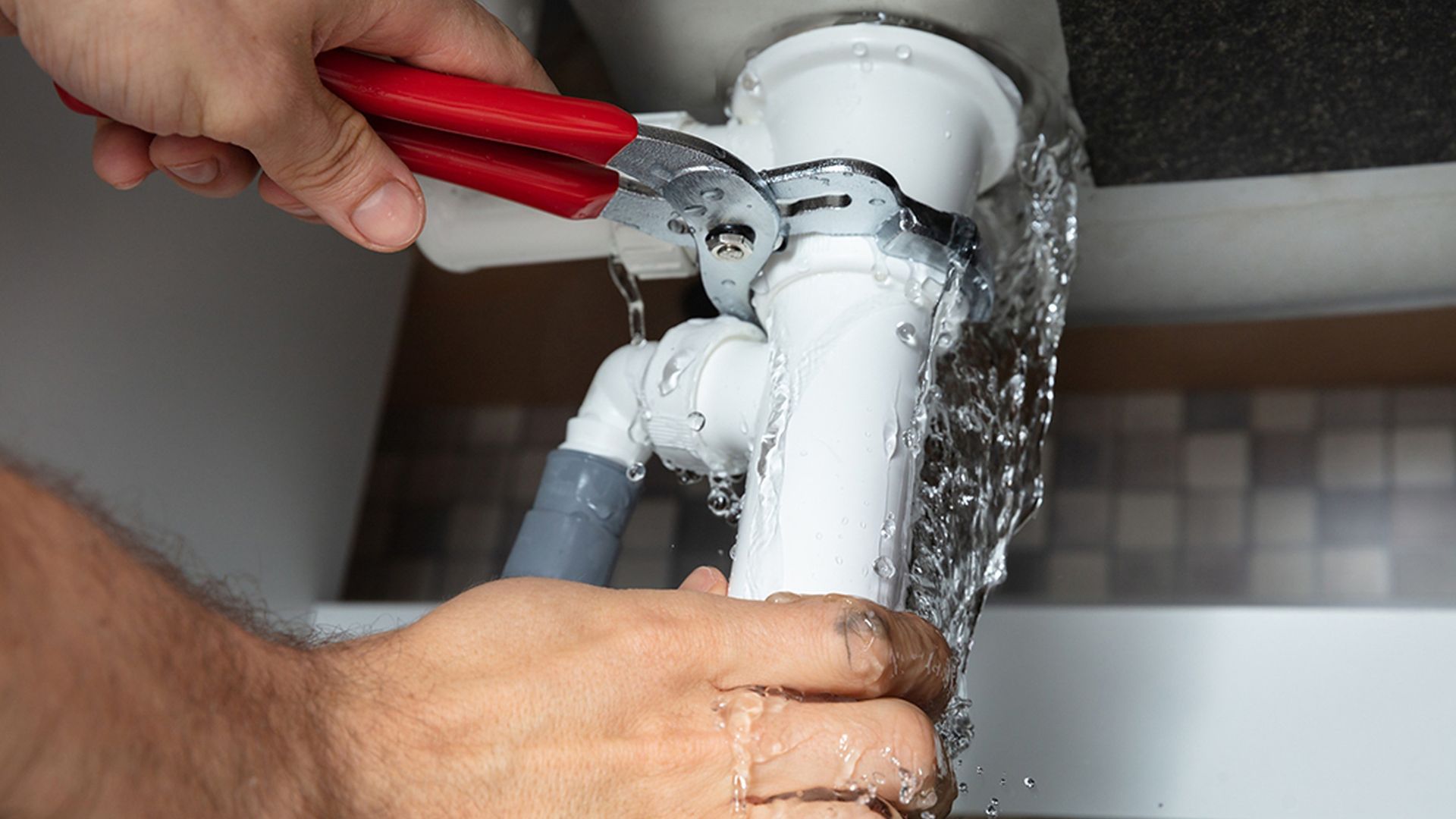
How to Become a Plumber in Nepal | Training, Salary & Scope
Do you know? AI is replacing many jobs, but professions like plumbing will never be replaced. It requires human effort to complete the job. Plumbing may not sound as fancy a job as other professions in countries like Nepal. But with growth in the construction field, the demand for skilled plumbers is increasing in Nepal. A plumber plays a crucial role in installing water systems, repairing sanitary pipelines, and maintaining the entire plumbing work.
For those who are looking for a career with stability, growth, and international opportunities, the plumbing profession could be the right path for them. In this article, we will guide you through the process you need to know for becoming a plumber in Nepal. You will understand the training requirements, scope, challenges, and future opportunities.
Understanding the Plumbing Profession
A skilled professional plumber who works with sanitary fittings, water supply, and drainage networks. It includes:
• Water pipeline installation and repair.
• Bathroom setup includes taps, sinks, showers, and toilets.
• Structuring and managing drainage systems.
• Work in construction fields to set up plumbing.
A plumber works for homes, offices, hotels, and industrial areas to maintain a clean water supply and safe waste disposal.
Why Choose Plumbing as a Career?
Here is why you should choose plumbing as a career.
• High Demand: With the growth of construction in Nepal, the demand for plumbers is increasing even in the international market.
• Job Security: As this is a must-have service for all, even in an economic downturn, it remains essential.
• Self-Employment: You can start your own business or provide only a service.
• Good Earnings: With experience and foreign exposure, plumbers can earn a competitive income.
Plumber Training in Nepal
Recognized Training Providers
• CTEVT: This is the government authority that manages the vocational and technical training in Nepal.
• Affiliated Training Institutes: Community schools, technical colleges, and NGOs running plumber training.
• Private Training Centers: Training institutions like Apex Skills Academy in Kathmandu and other cities provide certified training programs.
Duration and Cost of Plumbing Training
• Basic classes start from 1.5 months, but they can be extended up to 6 months.
• Course fees: Fees for plumbing training in Nepal start from NPR 10,000–40,000, depending on the institute and students' requirements.
What are the skills you will learn as a plumber?
Technical Skills
• Pipe installation and maintenance
• Sanitary fittings installation (toilets, sinks, showers)
• Water supply system repair
• Drainage and sewage system management
• Welding and pipe cutting techniques
Soft Skills
• Communication with clients
• Problem-solving.
• Safety awareness and hygiene practices
Certification and Licensing
CTEVT Certification
You will get CTEVT certification and even ISO certification from reputed institutions. This certification adds credibility and helps in foreign employment applications.
- Value of Certification for Employment.
- In Nepal, certified plumbers are preferred by construction companies.
- Abroad: Many countries only hire certified workers for plumbing jobs.
What are the career opportunities for plumbers in Nepal?
Employment in Nepal
• Construction companies
• Hotels and hospitals
• Factories and industries
• Government projects (water supply, sanitation)
Salary and Earning Potential
1. Nepal-Based Salary
• The salary for a beginner is NPR 15,000 – 25,000 per month
• Salary for intermediates is NPR 30,000 – 50,000 per month
• Self-employed plumbers: Income varies but can exceed regular salaries
2. Abroad
• The income in Gulf countries is around NPR 70,000 – 120,000 per month
• The income in Malaysia is approximately NPR 60,000 – 90,000 per month
• The income in countries like Europe/Japan is NPR 150,000+ per month
International employment offers much higher earning potential.
Challenges in the Plumbing Career
Like any profession, plumbing comes with challenges:
• Physically demanding work
• Exposure to dirt, water, and chemicals
• Irregular working hours
• Need to update skills with modern plumbing technology
But with the right safety measures and training, these challenges can be managed.
Steps to Become a Plumber in Nepal (Step-by-Step Guide)
1. Complete basic education (SEE pass or fail)
2. Enroll in a plumber training program (CTEVT or private)
3. Gain practical experience through internships or apprenticeships
4. Get certified with a CTEVT certificate
5. Apply for plumbing jobs in Nepal or abroad
6. Explore self-employment or start your own plumbing service
Future Scope of Plumbing Career in Nepal
The scope of plumbing in Nepal is only going to increase due to the following:
• Rapid urbanization and housing development
• Government focus on water and sanitation projects
• Growth of the hospitality and construction industries
• Rising demand for eco-friendly plumbing solutions (solar water systems, rainwater harvesting)
In short, plumbing is a future-proof career.
Conclusion
Plumbing is not just fitting the pipes; it's all about ensuring the clean water, sanitation, and comfort in people’s lives. Becoming a plumber in Nepal is accessible and highly rewarding. You can build a solid career in plumbing in Nepal with the right training, certification, and experience.
If you are a student looking for a career path after SEE or +2, plumbing could be the right choice to secure your future. Check out our course, Plumbing Training in Nepal ISO Certified, and get enrolled if you want to be skillful. Remember, skills open doors that academic degrees sometimes cannot. Explore more about plumbing training at Apex Skill Academy.
Here are some FAQs, which might be helpful to you
1. What is plumbing training in Nepal?
Plumbing training is a practical, hands-on course that teaches how to install, repair, and maintain water supply systems, sanitary fittings, drainage, and sewage systems in homes, offices, hotels, and industries.
2. How long does plumbing training take in Nepal?
The duration of plumbing training usually ranges from 1.5 months (basic course) to 6 months (comprehensive program), depending on the institute and course type.
3. Who can join plumbing training in Nepal?
Anyone can join. It is ideal for SEE graduates, school leavers, youth, construction workers, and people looking for a stable and high-demand technical career. No prior experience is required.
4. What skills will I learn in plumbing training?
You will learn pipe installation, sanitary fittings (toilet, sink, and shower), water supply and drainage systems, welding, pipe cutting, fault detection, repair techniques, and safety practices.
5. Which certificate will I get after plumbing training?
You will receive an ISO 9001:2015-certified certificate from Apex Skills Academy. Many institutes also help students obtain CTEVT certification.
6. How much does a plumber earn in Nepal?
Beginner plumbers earn NPR 15,000 – 25,000 per month. Experienced plumbers earn NPR 30,000 – 50,000 per month. Self-employed plumbers can earn significantly more.
7. Is plumbing training useful for foreign employment?
Yes. Certified plumbers have excellent opportunities abroad, especially in Gulf countries, Malaysia, Europe, and Japan, where salaries range from NPR 60,000 to NPR 150,000+ per month.
8. Can I start my own business after plumbing training?
Yes. Many trained plumbers start their own plumbing service or contracting business after gaining some experience.
9. What are the career opportunities after completing plumbing training?
You can work in construction companies, hotels, hospitals, factories, or government water & sanitation projects or work as a freelance plumber.
10. Why is plumbing considered a future-proof career in Nepal?
Due to rapid urbanization, a housing boom, government focus on sanitation, and growth in the hospitality & construction sectors, the demand for skilled plumbers is continuously increasing.
Skills Verification Program (SPV) in Nepal: A crucial step towards foreign employment.
The Skills Verification Program (SPV) is gaining significance among Nepali workers aspiring to work in other countries. Currently, many countries demand work permit or job visa applicants show their competence in practical abilities. The SPV is a tool to assist in determining if the worker has knowledge and technical skills to carry out the job safely and effectively.
Skills verification is a learning opportunity for Nepalis who want to work abroad and demonstrate their skills to international standards. It makes work more available as well as makes better quality jobs and career opportunities more likely.
The demand for skilled labor is growing, and skill verification can be an asset to anyone who has a technical or vocational trade.
What's the need for the Skills Verification Program?
The Skills Verification Program is designed to help ensure that workers are up to the necessary level for their profession. In many cases, employers and government authorities in destination countries rely on skill verification to check whether the worker is ready to work.
Some of the advantages of SPVs are:
- Practical skills are recognized by the awarding of a certificate.
- More opportunities to work in other countries.
- Increased employer confidence
- High visa approval rates. Increased opportunity for visa success.
- Higher earning potential
- Meeting international labor standards
- Professional career development
Skill verification for many workers can be evidence of skill and a way to be competitive in the job market.
The occupations listed below are occupations that are often required to have skills verified.
Technical and Vocational (TVET) workers frequently need to undergo skills verification in the following areas:
- Electricians
- Plumbers
- Welders
- Carpenters
- Industrial Automation Technicians
- HVAC Technicians
- Heavy Equipment Operators
- Masonry Workers
- Mechanical Technicians
- Construction Workers
Recognized skills are increasingly a key edge for job seekers as labor markets grow quality-oriented.
Career benefits of Skills Verification
Skill verification can lead to an improvement in employment opportunities both within Nepal and abroad.
|
Benefit |
Impact |
|
International Recognition |
Enhanced employability in a foreign country |
|
Skill validation |
It is the process of providing proof of professional competency. |
|
Increased job prospects |
Improved opportunities for skilled jobs |
|
Greater earning potential |
Improved job opportunities |
|
Career Growth |
Greater professional credibility |
|
Employer Trust |
It is the greater confidence of recruiters. |
Individuals who finish skill verification may benefit in their recruitment and placement efforts.
Candidates must attend Skills Verification at Apex Skills Academy.
For people preparing to take part in skills verification programs, Apex Skills Academy & Research Center offers hands-on and industry-relevant training. The preparation programs enable candidates to develop their technical knowledge, enhance their practical performance, and boost confidence prior to assessments.
The following could be made available as training support:
- Practical skill development
- Hands-on workshop training
- Trade-specific guidance
- Assessment preparation
- Use of safety procedures and best practices.
- Application of safety procedures and best practices.
- Mock practical evaluations
- Industry-standard techniques
This objective is to familiarize participants with the requirements of assessments and to carry them out effectively during skills verification examinations.
Why Apex Skills Academy for SPV Preparation?
Apex Skills Academy is rooted in a hands-on educational approach and is dedicated to preparing students for careers. The school assists individuals to fill in skill gaps and adapt to the needs of the workplace.
Key advantages include the following:
- Experienced instructors
- Practical training facilities
- Industry-relevant learning methods
- Assessment-focused preparation
- Physical and online learning support.
- Preparation of students for future career choices and planning.
- Certification-based training programs
Good preparation can enhance confidence and performance in skill assessments with or without the goal of employment abroad or to better equip yourself for your professional life.
Frequently Asked Questions (FAQs):
1. What does the Skills Verification Program (SPV) do?
A Skills Verification Program (SVP) is an evaluation mechanism that allows the assessment of a person's skills and technical competence in a particular trade or occupation. It acts as a form of verification that workers conform to industry (or international) employment standards.
2. Who should be subject to skills verification?
If an employer or country of employment requires it, the worker may need to undertake a skills verification for jobs in technical and vocational training (TVET) like construction, HVAC, welders, plumbers, and electricians.
3. Why is it important to verify the skills required for foreign employment?
Skill verification can lead to official skills recognition, boost the employer's trust, and enhance prospects of employment, salary, and visa application.
4. What can I do to prepare for a skills verification assessment?
Candidates can get their preparation done through hands-on skill development courses, mock tests and exams, trade-specific skill development courses, and practical training. It is important that children practice regularly and that they understand the criteria.
5. What are the places to prepare for skills verification in Nepal?
Apex Skills Academy & Research Center offers hands-on training courses that enable candidates to develop their technical skills and feel confident for conducting skills verification.
The importance of skills verification in the future.
There is a growing focus on certified skills and the quality of the workforce by global employers. Internationally, the labor market is becoming more competitive, and people with proven competency will be more competitive.
Skill verification is not just a test for Nepalis working abroad; it's a chance to demonstrate professional skills and enhance their career prospects. Preparing for success now through training and preparation can result in better opportunities in the future.
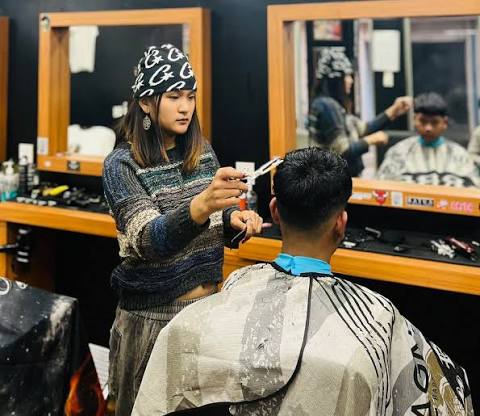
Barbering Career in Nepal: Job Demand, Salary, and Growth
If you are considering becoming a barber, then you are on the right page. If you are considering a career in barbering in Nepal, then this is the place for you.
If you are wondering about making a career in barbering in Nepal, you will want more than just a motivational speech: you'll want some figures. So how much is it worth? Do you have a market for your career? Is it better with age or early on?
Why More People in Nepal Are Considering Barbering as a Career
The rise in interest in barbering as a career in Nepal can be attributed to several factors. Several reasons contribute to the increase in interest in barbering as a career in Nepal.
Barbering is a skill that falls somewhere between the extremes of practical and hands-on and does not require years of formal schooling, yet it yields in-demand and steady work. Each neighborhood has its own barber, and the clients will remain loyal, like many professions, to the same person for years at a time.
In Nepal, many young people are seeking short-term certifiable skills such as barbering that do not involve a time-consuming degree program or a job in the corporate world.
What is the salary of a barber in Nepal?
Currently, there is limited information available regarding the salary for barbering in particular in Nepal, but the figures available provide a useful guide. According to one of the sources of salary, Kathmandu's barber earns around NPR 415,900 per year; the range is from around NPR 215,100 to NPR 633,300. It says that the average barber with a certificate or diploma education earns about NPR 518,300 per year, a substantial increase compared to their counterparts without formal training.
In comparison, the average monthly salary for all professions in Nepal is about NPR 32,000 (USD 234). A highly trained barber with a salary on the higher end of the scale, combined with tips, walk-in business, and repeat customers, can easily surpass a national average, something that is not usually reflected in formal salary surveys.
It should be noted that salary survey data does not really cover self-employed barbers (chair renters or shop owners) very well, as most salary surveys are based on formal employment. In reality, a lot of barber shops in Nepal receive extra salary through this besides their base salary.
Barber Salary vs. Other Common Benchmarks in Nepal
For a perspective on how much money can be made from barbering, let's look at the overall wage scenario in Nepal:
|
Role / Benchmark |
Approx. Monthly Income (NPR) |
|
Nepal's national minimum wage |
19,550 |
|
Nepal's average salary (all sectors) |
32,000 |
|
Fresher / entry-level jobs (general) |
15,000 – 25,000 |
|
Barber (certified, Kathmandu, average) |
34,600 |
|
Barber (certified, Kathmandu, high-end) |
52,700 |
|
Barber (certificate/diploma holder, average) |
43,200 |
Data shown are averages converted to a monthly basis and rounded for ease of reading
A Note on the Data
Available salary-tracking sources were used to gather the salary data in this article and cross-referenced with the wage statistics in Nepal in general to set a backdrop for the data. Think about them as benchmarks and not predictors. People do make more money based on where they work, the reputation of the shop, and the type of clientele they have.
If you're looking to find a job in Kathmandu that pays the national average, you might be better off looking for a certified barber.
Job Demand and Opportunities for Trained Barbers
The demand for barbering services is not a riddle in Nepal but steady, and it is a good riddle. It is not a trendy market; it is a service that is necessary in every community, city, and town. There are typically several different avenues for opportunities:
- Works in a barbershop/salon (most typical first job)
- Freelance or chair rental jobs have higher earning potential with more clients once you have established yourself.
- Many trained barbers dreamed of opening their own shop, particularly in the growing city of Kathmandu, the long-term objective for many.
Formal qualifications (not informal, self-taught skills) can become important to employers, as a barbering trade that relies on hands-on skills demonstrates reliability, hygiene standards, and a consistent technique, which in turn is an indicator of a shop's reputation with customers.
The way career growth is realized
Barbering is a relatively typical career path:
Junior barber / trainee (Years 0–1): It is a period of time in which the individual is still developing speed and consistency, typically resulting in a lower end of the salary range, unless they are working under supervision.
Repeated meetings with customers (Years 1-3): Tips and repeat business begin to boost income from base pay, and referrals begin to get more customers.
Senior barber / chair owner (Year 3+): If the owner of the barber shop is a senior, he/she may be able to charge premium prices at a stable shop or own a chair where income is no longer a fixed salary but is based on what the chair earns.
Shop owner: If you are looking for a bigger opportunity, a shop will no longer have to be limited to one pair of hands; it will be making money with several barbers and an increasing number of customers.
It's a reason that appeals to those who want long-term potential as opposed to simply a paycheck; there’s no salary cap here like there is in many office jobs.
What skills and training are required to get started?
The best barber training program will include more than just hair cutting. As a minimum, seek out training in:
- Using clipper work, fading, and the scissors-over-comb technique.
- Straight razor shave & hot towel service.
- Shaping beards and basic coloring of hair.
- Good hygiene and sterilization of tools
Know how to communicate with clients and have basic business skills such as pricing, scheduling, and upselling.
When a program integrates business education with technical training, graduates will be prepared to go right into work or to begin their own shop later.
Is Barber Training Worth the Investment?
Considering the fact that certified barbers would seem to be able to make a bit more money than the national average and a whole lot more than the guys who don't have formal training, it really doesn't take long for a quick training course that is a bit inexpensive to pay for. Barber training isn't the same as a multi-year degree program, so you'll be making money much sooner.
The larger value, however, tends to manifest over time: certification opens up better shops, better-paying customers, and eventually even the option to become self-employed, something that is much more difficult if one only has self-taught knowledge.
Frequently Asked Questions
What is the duration of a barber course in Nepal?
Most of the certificate programs for barber training are conducted for about 1 - 1.5 months of intense hands-on learning, which means you can be going from learning to earning in a couple of months.
Do you have to have experience to get started in barber training?
No. Sane programs are created for novices who have never attempted to work with a manikin and lead with basic skills, such as tool control and mannequin practice, and then move on to live models with supervision.
Is barbering a career or an entry level?
It may be either, depending upon the route you take. The higher long-term earning potential typically occurs when you start as an employee at a barber shop or chair rental arrangement and eventually become a chair owner or shop owner.
Does certification impact compensation?
The data on salaries available shows that there is a significant difference in average salary between certified or diploma barbers and those not trained, and that certification also appears to provide access to better shops and job opportunities.
What is the difference between working at a shop and being the owner of a shop?
You have a steady paycheck and less risk in working at a shop, and you develop your skills and clientele. Running a store (or renting a chair) has greater earning potential, and it has more responsibilities, such as those of managing costs, hours, and possibly other people in the job.
How to begin a career in barbering in Nepal?
If the figures above are giving you a good idea of the deal, the next step is to find a training program that is appropriately certified, has an appropriately small class size to allow for hands-on learning, and provides support after completion of the program, such as job leads, references, or further guidance in opening a barber shop in the future.
Learn about Apex Skills Academy's Professional Barber Training Course
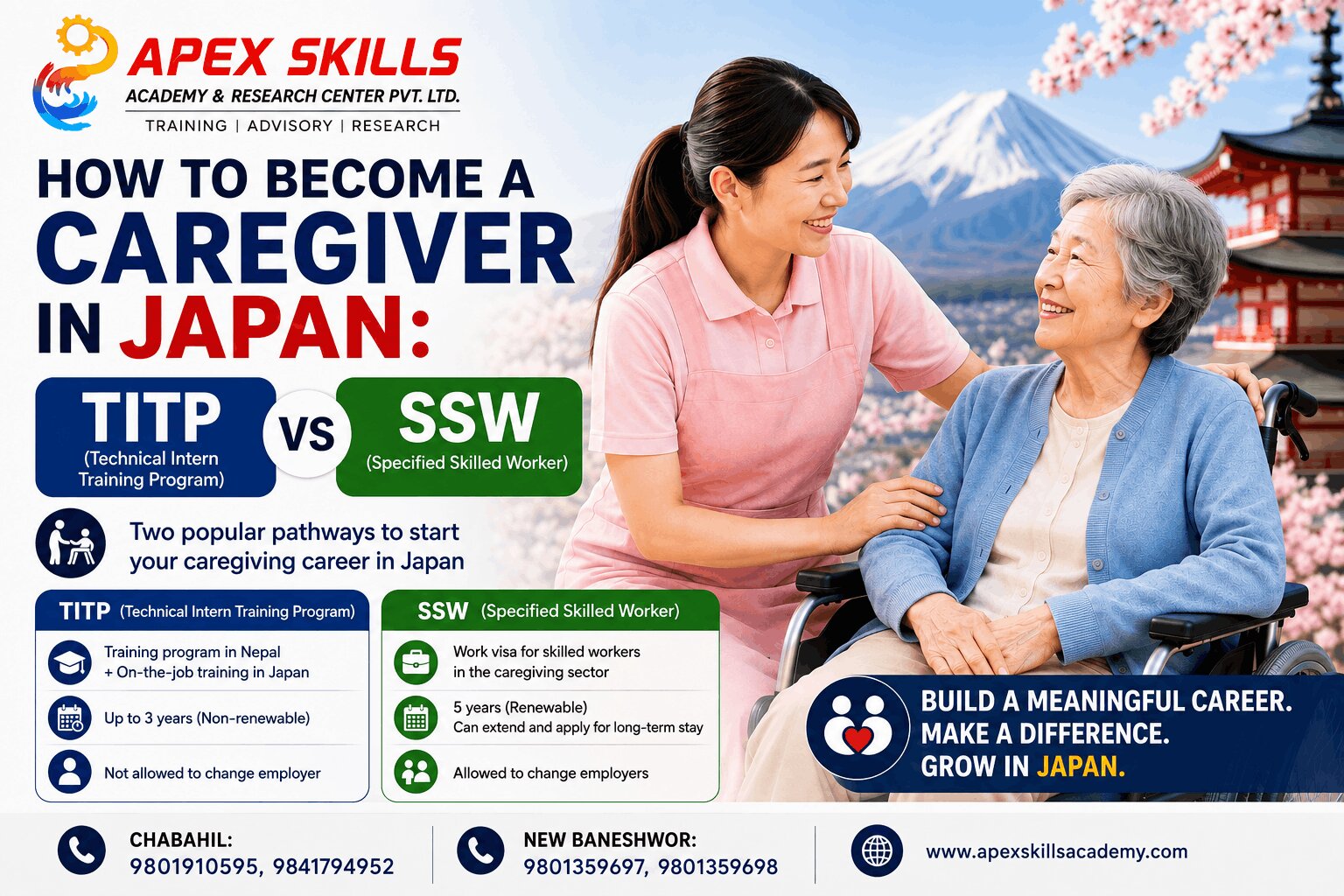
How to Become a Caregiver in Japan: TITP vs. SSW Explained
The number of people who have a number of opinions and answers about TITP and SSW is high; most of them would be wrong, some would be outdated, and barely one would be right about it. That is the main problem with this topic for anyone who is trying to land the caregiving job in Japan. It is not that the information does not exist; it is that most of the information about it floating around Kathmandu is either half-remembered or half-true.
So, here is the actual comparison about it for the applicants from Nepal: the requirements and the criteria as they stand in the present, and one change that is coming to Japan’s system that will affect anyone planning to leave in the next two years.
What is TTIP?
TTIP, in general terms, is the Technical Intern Training Program that has been running since 1993. On paper, it is a skills transfer scheme: when you go to Japan, a company trains you, and you bring that experience home. In practice, for more than three decades it has been fully functional as Japan’s main channel for foreign labor in sectors that could not fill the position locally, a caregiver among them.
The entry bar is low. You do not need any prior work experience or advanced Japanese to get in, which is exactly why it has been the default starting point for so many Nepali applicants. You are placed with one employer for the length of your contract, typically building up to five years; you are expected to go home when the contract ends. Changing employers’ mid-program is almost never allowed, only in some rare cases like some mishap- or proven-abuse-related situations.
That is one single detail: being blocked by the employer is the major and the root of the most TITP complaints you’ll hear from the returners. If the workplace is fine, the program is fine, and if it is not fine, then you will have very little room to move.
What is SSW?
SSW, Specified Skilled Worker (Tokutei Ginou), is a program that was launched in April 2019 as Japan’s direct answer to the labor shortage that TITP alone could not cover. It comes in two tiers: SSW Type 1 and SSW Type 2. In Type 1, almost everyone starts with a straightforward visa, which is tied to their work sector, which is renewable and capped at five years total. Whereas in Type 2, it is for those people who have moved into the supervisory or the advanced roles, and it opens the door to bringing family and staying indefinitely, something that Type 1 does not allow.
The actual difference between these two is that SSW workers are employees, not the trainees. The wages must match the same or beat what a Japanese worker doing the same job in the same region earns, and you are legally free to switch employers within the same field without needing anyone’s permission, provided that the new employer is a registered SSW-accepting organization. But doing the same on TITP is not allowed; you might get deported back to your home country.
By early 2026, roughly more than 350,000 people who were working in Japan are under the status SSW, against a government target of about 820,000 by 2029. Caregiving is one of the sixteen approved SSW sectors, and Nepal is one of the recognized sending countries feeding that pipeline, alongside with Vietnam, Indonesia, and the Philippines.
TITP vs. SSW at a glance
|
Category |
TITP |
SSW (Type 1) |
|
Purpose (official) |
Skills transfer / international cooperation |
Filling labor shortages |
|
Japanese level to enter |
No fixed minimum |
JLPT N4 or JFT-Basic |
|
Extra caregiving requirement |
None to enter |
Nursing Care Skills Test + Nursing Care Japanese Test |
|
Max stay |
Up to 5 years |
Up to 5 years (Type 1), longer via Type 2 |
|
Can you change employers? |
Essentially no |
Yes, within the same sector |
|
Wage protection |
Not guaranteed to match local rate |
Must match or exceed local market rate |
|
Family allowed |
No |
No on Type 1, yes on Type 2 |
|
Path to settle long-term |
Not directly |
Yes, via Type 2 or the Kaigo (licensed care worker) status. |
|
Who it suits |
First-time applicants with no prior training or experience |
Applicants who've cleared the language and skills tests or completed TITP already |
The part where most blogs haven’t updated about this topic yet
The TTIP program is about to be retired. The Japanese government passed legislation in 2024 to replace it with a new framework called Employment for Skilled Development, known in Japanese as IKusei Shuro. Official guidelines were only finalized in early 2026. The new plan is for the new system to start in 2027, with the last group of TITP entrants going in around mid-2027 before the old program gets completely closed for good.
The actual reason and logic behind this switch is worth knowing, even if the mechanics are still being worked out. IKusei Shuro drops the “training, not labor” with a structured three-year runway into SSW Type 1. Employers will reportedly be required to fund a minimum block of Japanese language instruction early in the contract, and the new system is expected to cap total intake at roughly 425,000 workers for its first two flowers, a deliberate move toward controlled, outcome-based migration rather than open-ended intake.
If you are planning your Japan timeline around early 2026-2027, this matters. Anyone entering under old-styled TITP close to the cutoff may find themselves navigating a transition rather than a clean five-year program. Talk to your training institute about which side of the line your application will fall before you commit to it.
What the SSW caregiving route actually requires
Caregiving (kaigo in Japanese) comes with an extra layer; most other SSW sectors do not have. You need three things cleared.
- General Japanese proficiency: JLPT N4 or JFT-Basic (roughly A2 level, daily conversation, basic reading, following simple instructions)
- Nursing Care Skills Evaluation Test: a practical and written exam on personal care, mobility support, hygiene, and dementia care basics
- Nursing Care Japanese Language Evaluation Test: a separate, caregiving-specific vocabulary and comprehension test, because "please turn left" and "let's help you sit up without straining your hip" are not the same sentence
They've all been administered by Prometric, and they're now available in Kathmandu, thus eliminating the necessity to fly anywhere to take the test. Allocate 4 – 6 months of intensive preparation if you are starting from scratch; longer if you are beginning at “actual zero” Japanese and not at “book zero.”
As for the later stages of TITP (Technical Intern ii or iii) in caregiving, there's one shortcut to know: generally, if one finished the later stages of TITP in caregiving, he or she will not have to take the skills test or the language test when moving to SSW in the same field. This is the key factor in many people's perception of TITP as a steppingstone to SSW rather than a program.
Wages and working conditions, generally speaking
The salary for entry-level caregivers at SSW is frequently cited to be between ¥220,000 to ¥280,000 per month before deductions, which is often several times higher than the caregiver's salary in Nepal; salaries vary by prefecture, facility type, and experience. Always get in writing what they will be paid before signing anything. It is important to keep in mind that the wage-parity rule prohibits being paid less than a Japanese worker with the same job at the same company.
Now, one more thing we would like to say: When it comes to getting a legitimate placement, they should never ask for a big up-front cash payment without you seeing a job offer first. Do not let an agent ask you for lakhs before they present you with a contract. Before you give a single rupee to anyone, make sure that the person is on the recognized sending-organization list.
So which one should you actually pick?
For a first-time applicant from Nepal, with no Japanese experience and no caregiving experience, and an employer lock-in is not an issue, and you want the lowest entry barrier, TITP / Ikusei Shuro (on the way to become the latter) is the more lenient on-ramp, if you know exactly what you have to do come 2027 and understand the employer-lock issue.
If you already have JLPT N4 or can reasonably obtain that in several months, and you would prefer a more realistic long-term future in Japan from the get-go and some level of job mobility / wage protection, then SSW is the better route, and the one that can lead to a real long-term future in Japan with Type 2 or the licensed Kaigo Fukushishi status.
Either one way or the other, the on-ramp is the same: CTEVT-recognized care-and-taking training and a structured Japanese language training before taking any Japanese exam, not after you have booked a flight.
Where Apex fits into this
Our Elderly Caregiver Training is designed around this juncture in caregiving and empowers you with the knowledge of the basics of caring for the elderly, both paths that CTEVT has already taught you, plus the language fundamentals that you wouldn't want to walk into the Nursing Care Japanese Test blind. Contact the course page for current batch timings & fees and any questions regarding the pathway you're interested in. We prefer to discuss it with you rather than you discover the hard way from a previous agent who has moved on to the next client. Our Caregiver program covers all the details you need to know for it
FAQs
May I change from TITP to SSW during?
Yes, this is a very popular transition. The completion of TITP in the caregiving pathway typically waives the SSW skills and language assessments in caregiving.
Will I need to know the Japanese language before I begin training in Nepal?
No. The majority of applicants start studying language at the same time or prior to their course in caregiving. Most learners who have no knowledge of Japanese and study with a purpose can achieve the N4 level in 4-6 months.
Is TITP being cancelled immediately?
No. The old TITP system is gradually being phased out, with the new Ikusei Shuro system scheduled to start in April 2027 and the last entries into the TITP scheduled to be received around mid-2027. The status is still being finalized by the Japanese government; please check with your training institute before applying.
May I go to Japan with my family as a career?
Not TITP or SSW Type 1. Family accompaniment is available in the SSW Type 2 (advanced qualifications and supervisory experience) or Kaigo (fully licensed).
Is it better to earn TITP or SSW?
There is also SSW's legal wage parity: the amount of pay depends on the amount received by a Japanese worker in a similar position in a comparable area. Wages for TITP are not guaranteed, so SSW roles generally fare better than the entry level.
Contact us or visit our website, Apex Skills Academy, to get to know more about these skills training.
Elderly Caregiver Roles and Responsibilities | Complete Guide
What does an elderly caregiver do? Roles and Responsibilities
An older person can have someone who has more experience caring for them to help them live their daily life safely, comfortably, and with dignity. The job might be different for everyone. There is a need to assist some older people to get dressed and bathed. There is a need to assist some older people with bathing and dressing. Some may require assistance in eating, getting around, taking medication, or regular health check-ups. Others simply require human interaction, as they are alone or only have minimal family contact. The caregiver becomes a safe, trusted contact for the older adult to stay safe and active. Home-based personal care workers assist individuals with daily activities that are restricted due to aging, sickness, injury, or other circumstances, says the World Health Organization. Some of these may be related to personal care or moving around in the house. Care work also includes the implementation of an agreed care plan and co-working with health professionals if required.
Before selecting elderly care as a profession, it is essential to comprehend the position. A caregiver is not just a person who "stays with the elderly. There are numerous tasks to do in the work that need care and good judgment. Caregivers might cook breakfast, help with bathing and making sure the person is comfortable, and aid in moving around the home safely. Later, the same caregiver can assist with a visit to a clinic or provide information to the family about a change in the older person's health. The caregiver should also be aware of tasks beyond his or her scope of responsibility. It is important for decisions related to health to be made by qualified health workers. Caregiving is a good thing to do but not to deprive the older person of their independence. It involves providing the appropriate support and enabling the person to do as much as they can safely do.
What is an elderly caregiver?
An elderly caregiver is someone that cares for an older person regularly in their daily lives. The caregiver can be employed in a private house, elderly home, care home, hospital, or care setting. The amount of assistance needed depends on the older person's condition and abilities regarding health, age, mobility, memory, and individual needs. Some people need assistance only in eating and housekeeping. One may require assistance in almost all areas of the day. The first step is for the caregiver to learn what the person can do for themselves and what type of assistance is required. This helps to guarantee prevention of neglect and unnecessary dependence. Common caregiving tasks include things such as personal care, food preparation, household tasks, health care support, and medical coordination, according to the National Institute on Aging.
The Main Goal of Elderly Care
The primary objective is to maximize an older person's safety, comfort, and independence. A good caretaker does not care for an older person as a child. Old age is not an excuse for not having the right to choose in day-to-day activities. The caregiver should ask permission and describe in detail what is being done before providing personal care. This is a straightforward solution that helps to foster trust and dignity. The caregiver also monitors for signs of change that might indicate a health problem. Changes to walking or eating, sleeping, mood, or behavior could require attention. Care should be grounded on the individual's needs and not on a prescribed schedule, which fails to consider his/her preferences. Good care is about supportiveness, not controlling.
Daily Personal Care Responsibilities
One of the most prevalent areas of providing care for the elderly is the provision of personal care. As a person gets older, they may become weaker, lose their balance, have their vision get worse, or not be able to move as much as they used to. Other people may also suffer from diseases that make it difficult to perform normal tasks. A caregiver may be able to assist with the physical aspect of the job without taking away the person's participation. It's not to do all their work for them. The goal is to ensure tasks are done safely when they cannot do them on their own. Activities of daily living are bathing, dressing, eating, using the toilet, getting out of bed, and mobility. WHO uses these activities in its description of the daily needs of people of older age.
Bathing, Dressing, and Grooming
Take your time in the bath; don't rush it, as wet floors can be a serious fall hazard. The caregiver can set up the bathroom, put out clean clothes, check the water, and be around in case of an accident. An individual who is older should be provided with as much privacy as possible while the process is going on. Clothing/Ropa may be the selection of appropriate clothing or assistance with buttons, zippers, socks, or shoes. Grooming can consist of basic care, such as brushing hair, cleaning teeth, shaving, trimming nails, and more. These tasks might appear to be minor, but they can make a difference in comfort and confidence. An older person's appearance may enhance his/her sense of self if it is clean. It is also important for caregivers to monitor skin for signs of redness, wounds, swelling, or other changes and to report any concerns as appropriate.
Toileting and Mobility Support
Sensitive care and respect are important at each stage of the toileting process when caring for the elderly. A few older people require assistance to reach the toilet due to weak legs or poor balance. Others may be given walking sticks, a commode, and other support. A caregiver may be able to assist the person to move in a safe manner without pulling or unsafe lifting. Correct body movement is important because incorrect movements can injure the caregiver and/or the older person. Mobility support is aiding getting out of bed, into a chair, or between rooms. An area of walking should be kept clear, and items of use should be kept within easy reach for the caregiver. Safe movement maintains older people's activity and helps to minimize the risk of injury.
Food, Water, and Nutrition
A caregiver's daily responsibility also includes food support. A person who is older may not have the same appetite as they did when they were younger or may require a special diet due to a medical condition. The caregiver can make simple food, feed and water the fussy child, and monitor if the child changes their eating habits. Feeding assistance can also be required if the senior has weak hands, poor eyesight, or a problem transferring the food from a plate. Caregivers must adhere to the care plan and any directions by qualified health workers. They should not make medical diets or alter treatment without proper advice. Any weight loss, difficulty in swallowing, frequent vomiting, or sudden loss of appetite should be reported. A healthy diet helps to maintain strength, energy, and overall good health.
Health & Safety Responsibilities
The elderly caregiver is a vital part of health and safety in day-to-day life, but this is not a substitute for a doctor or nurse. The older person is more likely to be cared for by the caregiver than by any other care team member. This is because they might be the first to see any changes. They can make simple observations and communicate with family members or health workers. The caregiver can also aid the older person in carrying out an already in place care plan. This may involve whether someone goes to appointments, maintains health records, and reminds the person to take medicine on time. Care workers are defined as individuals who, in the course of their work, normally have care plans and work under suitable professional supervision, according to WHO.
Support for medicines and health records
Errors in medicine support can have serious consequences, so it's important to get it right. A caregiver can remind an older person when medicine should be taken or arrange information about medicines. Specific tasks will vary based on the individual care plan and local regulations. If the medication has a particular name, time, and instructions, the caregiver should be familiar with names, time, and instructions. They should never guess a dose or decide on stopping medicine! The National Institute on Aging recommends a clear medication list and monitoring of time and dosage prescribed by the doctor. It also advises against the use of a combination of medicines or using them in the wrong way.
Care can be made easier with health records as well. When necessary, a caregiver could document meals, water, sleep, movement, appointments, behavioral changes, etc. Note-taking promotes understanding by families and health workers of what occurred during the day. The caregiver should ensure that personal information is kept confidential and only shared with those who have a valid reason for having access to it. The key to making good records is simplicity. Sometimes simple facts will suffice. A caregiver might record, for instance, that the individual ate half of lunch, slept poorly that night, or walked poorly in the morning.
Fall Prevention and Home Safety
Falls are a major issue for older people, particularly for those who find it difficult to maintain balance or move about. It is important to inspect the home for potential hazards. Rugs, wet floors, insufficient lighting, clutter, and objects in pathways can be issues. Items that are used on a regular basis should be stored within easy reach of the older person. Additional support may be required for bathroom facilities, as water can cause slip hazards. Additionally, the caregiver needs to ensure that any walking aids used are used properly. Safety checks should occur each day as part of the care and maintenance, not after there has been an accident. The following are recommendations from the National Institute on Aging about steps you can take at home to minimize the dangers of falls and hazardous household objects.
If a caregiver needs to get medical assistance.
It's important a caregiver understands when the situation requires professional assistance. If there is serious difficulty breathing, chest pain, heavy bleeding, loss of consciousness, a large injury, or other life-threatening symptoms, these should not be treated by guesswork. The caregiver is to act according to the instructions in the family/health team's emergency plan. They should be cool and provide clear details about what has happened. Other less urgent changes to report to a caregiver include unusual confusion, repeated falls, fever, sudden weakness, or significant eating changes. Reporting as early as possible will allow the care team to act sooner. The role of the caregiver is to observe, encourage, record, and report. It's not for the purpose of making a diagnosis with the elderly person.
Emotional and Social Support
Physical care is just one aspect of elderly care. Older adults require friendship, conversation, and a sense of connection as well. No one must feel alone when they have food on their table, medicine, and a clean home. A caregiver can engage in simple activities with the person, such as spending time talking, listening, reading with the person, or going for a walk. These moments can help to make the day more normal and meaningful. The caregiver should find out what the older person likes, rather than picking activities for him/her. Others enjoy listening to music or reading books. Others like to cook, garden, do religious activities, watch television, play games, or reminisce about family experiences. Social support should be in line with the person's interests and abilities.
Companionship and Mental Wellbeing
One of the most important aspects of caring can be companionship. The adult who cares for the older person might be the chief person that the older person talks to throughout the day. When listening, avoid rushing and give the person a sense of respect. The carer may allow for safe social interaction with family, friends, neighbors, or groups within the community. They may also be useful to help keep a person interested in the daily routine, such as simple hobbies. An alteration of mood is not to be overlooked. If there is sadness, fear, confusion, anger, withdrawal, or unusual behavior that is ongoing, it should be discussed with the relevant family member or health worker. The caregiver should NOT blame the older person for their hard feelings. At times a presence and an ear are the best help.
Supporting people who are older with memory problems
Extra structure and patience may be required for adults who are older and have memory issues. Simple reminders, a calendar, notes, familiar routines, and clear instructions can be used by a caregiver. For individuals with cognitive difficulties, the National Institute on Aging offers practical solutions like reminders, calendars, and safety aids. Do not argue with the person when he or she is confused. Giving a simple answer may be better than giving a lengthy answer. When memory issues cause problems with judgment, the home needs to be evaluated for safety hazards as well. The emphasis should be on abilities and not solely on loss.
Understanding Respecting Privacy and Personal Choice
Respect is the core of high-quality aged care. Elderly people have their own habits, beliefs, likes/dislikes, and stories of life. Before approaching anyone's personal items or private areas, a caregiver should ask. They should verbalize what they are about to do for their personal care prior to doing the task. Wherever possible, the older person should have a choice, for example, in clothes or in when to take a walk. Bathing, dressing, toileting, and talking about health are areas of concern with privacy. Also, a caregiver should refrain from talking about the person when they are not there. It is as significant to treat him or her with dignity as it is to assist him or her in physical matters.
Support for household and daily living tasks
Even for older adults that can carry out some personal care, there are things around the house that require assistance. Difficulty in cleaning and shopping because of weakness, pain, poor vision, or limited movement. The caregiver can assist with maintaining living space cleanliness and organization. They can wash clothes, cook food, shop for essentials, or perform basic household chores. These responsibilities should be in line with the person's care and not make the person a general house worker. Duties should be agreed upon prior to the work being done. Defining expectations is good for both the older person and the caregiver. The aim is to have a safe and comfortable home.
Cooking, cleaning, and laundry.
The cooking should be appropriate for the person's nutritional requirements and personal tastes. If necessary, the caregiver can cook breakfast, lunch, dinner, and simple snacks. They should maintain the safety and cleanliness of the food and food preparation surfaces after use. Areas that the older person uses, particularly bedrooms, bathrooms, kitchens, and walking areas, can be the focus of cleaning. Washing, drying, folding, and storing clothes away may be included in laundry. These can be included in the routine of the day! The child's carer should also be aware of hazards when cleaning. Some strong cleaners, hot surfaces, sharp tools, and wet floors may pose a risk if not used safely.
Visits for shopping and medical purposes
Shopping assistance can be arranged for the purchase of food, household chores, hygiene, and approved items. Use of a clear list and receipts should be used by the caregiver as needed. With medical visits, you can help with preparation, transportation, carrying important medical information, and assisting with communication. It is important that a caregiver write down questions before an appointment to ensure important information isn't forgotten. They may also be able to take notes from the health professional when asked. The caregiver is not to make treatment decisions based on their own views. Their job is to assist the older person to comprehend and adhere to medical suggestions.
Communication and Family Support
Communication is the key to organizing elderly care. A caregiver will be in regular contact with family members, doctors, nurses, therapists, and other care workers. There may be different components of the care plan for each person. The following information must be shared with the caregiver in a useful way without causing confusion. Family members may wish to be given regular updates on what is happening with meals, sleep, exercises, appointments, and mood. There may be a need for more specific information from health workers regarding symptom changes or changes in daily functioning. Clear communication = everyone works for a common purpose. It also ensures that no small issues go unnoticed.
Working with Families and Health Workers
Caregivers should be aware of the responsibilities of everyone. Family members can manage finances, legal issues, or other significant decisions. The choice of treatment of the illness is made by the nurse or doctor in their capacity as professionals. The daily support is given by the caregiver. WHO recommendations emphasize the importance of differentiating care responsibilities in a care network. This way, no one will be taking on the responsibility of another. It also provides the older person with more support. A team with a good attitude performs better than a group of individuals, each with their own set of directions.
Reporting changes in health and behavior
It's important for a caregiver to see changes, as part of the job is to watch for them every day. They may see the older person sleeping more, eating less, walking in a different way or appearing unusually confused. Sometimes a single change is not necessarily an indication of a serious issue. However, any changes (unusual or sudden) should be communicated as per the care plan. Clear facts are used in good reporting and not guesses. When someone does not eat breakfast, it's not as helpful to say that they're getting unhealthy as it is to say that they didn't eat breakfast. Documenting the time of the change can also assist health workers in understanding.
List the skills that an elderly caregiver should possess
There are two types of skills a good caregiver must have: skills and people skills. Tasks can be taught like personal hygiene, nutrition, first aid, safe movement, and basic care. But just because somebody knows about technology doesn't mean that they are good caregivers. Patience, kindness, clear communication, and respect are also important traits of the person. Routine care can be exhausting, as there may be various needs each day. A caregiver will need to remain calm if an older person is slow, confused, upset, or refuses help. They also need to know when they are over their limit and when they need assistance when they cannot do something.
First Aid and Basic Care Skills
First aid can be useful, as it does not always occur in the care center or at home. Basic first aid, hygiene, nutrition, emergency response, and safe care practices are topics that might be included in the training of caregivers. The CTEVT caregiver training programmed in Nepal covers topics like handling first aid, hygiene, nutrition, emergency care, comfort measures, etc., and monitoring the well-being of clients. It also covers issues that older people may experience, including urinary issues, constipation, joint pain, back pain, prevention of bedsores, simple exercise, oxygen care, and sponge bathing. These are the skills that will enable caregivers to have a more solid foundation for their daily activities. Thorough training can also enable them to know when to seek professional medical attention.
Patience, empathy, and communication skills
One of the greatest attributes of good elderly care may be patience. Elderly people might have a slower movement response, speech, and eating and drinking and may not be able to do simple tasks as quickly as they used to. The hurried caregiver can make the individual feel helpless. A caring person provides sufficient time and maintains the organization of the day. Empathy is important because it enables the caregiver to see things from the other person's point of view and understand how they may feel when some of their independence is taken away. Communication helps to alleviate fear, too. Earning respect with simple words, a calming voice, and respectful questions can make difficult tasks easier. These are all things that can't be replaced with equipment or technology.
Want to Develop These Caregiving Skills Professionally?
Understanding the responsibilities of an elderly caregiver is an important first step, but developing these skills through structured practical training can help you become more confident and prepared for real caregiving situations. If you are looking to build these skills in Nepal, explore our Elderly Caregiver Training in Nepal, which covers personal care, mobility assistance, nutrition, dementia awareness, infection prevention, first aid, communication, and other essential caregiving skills.
A typical daily routine for an elderly caregiver
A 'typical day' is dependent on the needs of the individual and the care plan. The first step in the process may be to review the older adult's sleeping habits and “how he feels” in the morning. They can subsequently assist with washing, dressing, toileting, breakfast, and moving. They can help with food prep, medicine schedules, cleaning up important spaces, and other activities that require safety during the day. They can also be able to offer support and companionship as well as making appointments or communicating with family members. The evening provides them with assistance with dinner, personal care, bedtime routines, and safety checks. The caregiver could also write down information that is important for the next caregiver or the family member. The routine offers structure, and good care will leave room for the person's choices.
Conclusion
An elderly caregiver does more than just reside with the elderly person. This job has personal care, daily support, safety, companionship, household help, and communication aspects. In the morning a caregiver can help bathe you, prepare food at noon, go to the doctor later, and be with you in the evening. Specific tasks will be determined by the individual's care plan and needs. Good care safeguards safety and helps to maintain individual independence and dignity. The caregiver should be familiar with the steps to take, the information to report, and when to seek professional assistance. If you are interested in this career, you can get a solid start in working with the elderly if you receive the proper training as a caregiver. The CTEVT caregiver curriculum addresses several helpful topics in Nepal, such as health, hygiene, nutrition, emergency care, and client support.
FAQs About Elderly Caregiver Roles and Responsibilities
- Which is the primary duty of an old caregiver?
This involves assisting an older person to live daily life safely and comfortably. This may involve personal care, feeding, mobility, chores, comfort, and companionship, as well as care within a pre-established care plan. The caregiver also should be aware of significant changes and alert the appropriate individual.
- Elderly caregiver gives medicine?
Reminds an older person about medicine or offers medicine support as part of the caregiver's role and care plan. They should not alter dosages, discontinue treatment, or make medical decisions without the proper medical guidance. Use of medicines must be guided by the local rules and instructions of qualified health personnel.
- What kind of personal care does an old-age person give?
Personal care may involve bathing, dressing, grooming, toileting, feeding, and walking safely. The amount of assistance will depend on the older person's ability to function independently. A good caregiver enables a person's independence rather than performing all tasks for the person.
- Is there a need for training for an elderly caregiver?
Training is very beneficial because elderly care requires safety skills and hygiene, nutrition, first aid skills, communication, and basic care skills. The CTEVT caregiver curriculum includes some of these areas. Education can assist a new caregiver in the proper care techniques and identify situations requiring professional intervention.
- Is it possible for older people to be able to work abroad?
Yes, trained caregivers can work in other countries if they comply with the training, language, visa, and employment criteria. The specific requirements vary according to type of job and foreign country. Individuals intending to work overseas should consult with the current regulations of the country they wish to work in before making their applications.
Top 5 Training Centers in Kathmandu | Courses, Fees & Reviews
Nepal's job market is undergoing a significant transformation. While degrees are still important, employers are more interested in what you can do from the get-go. As a result, more students, career changers, and working professionals are choosing vocational and IT training institutes to develop job-ready skills in a matter of weeks or months.
These days, there are dozens of training institutes in Kathmandu, but they are not all equal. Some specialize in hard skills and trades like electrical work and plumbing, and others specialize in coding, design, digital marketing, and more. There are different fees, batch sizes, practical training, certification options, and career assistance available at different institutes; hence, it's necessary to pick the right institute before you put your money and time into it.
The comparison of five training centers in Kathmandu, i.e., Apex Skills Academy, Saarathi Academy, Broadway Infosys, LetsLearn, and Skills Factory Nepal, is done on this guide. You will learn about the courses they offer, the approach they take to training, the opportunities for certification and practical learning, the feedback they get from students, and where they are based with a comparison table to make it easier to make your shortlist more quickly.
APEX SKILLS ACADEMY
About Apex Skills Academy
Apex Skills Academy and Research Centre is a CTEVT-affiliated vocational training institute with ISO 9001:2015 certification, which was established to bridge the gap between theoretical and practical learning with the real job market. It operates from two campuses in Kathmandu with over 130 trainers and staff combined.
Courses provided
Apex has a catalog of hard skills courses and soft/digital skills courses. They are:
- Elderly Age Care Program
- Plumbing training
- Welding Training
- Industrial wiring training
- Motor rewinding training
- Auto mechanic training
- Motorcycle mechanic training
- Electronics troubleshooting training
- AC and refrigerator repair training
- Professional barber training
- Digital marketing training
- Video editing training
- QA training
Practical training and facilities
Training takes place in real workshops and on the premises and not in a lecture hall. The barber course is a practical course where students use tools from the first day of class, as shown in the photos of Apex. Students start out using mannequin heads and then move onto live models.
These are all Apex courses that have been affiliated with CTEVT and, where applicable, are ISO 9001:2015 certified by Apex. That's because in the Nepalese job market, people's resumes are viewed more considering CTEVT recognition, and the ISO certificate is designed to give employers an idea that the training is consistent and rigorous behind the paperwork.
Student feedback
Students consistently praise the hands-on aspect and the ability to choose morning or evening course sessions based on schedule according to other work and campus. Review of Apex Skills Academy
Locations: Chabahil-07, Gopikrishna, and New Baneshwor, Suruchi Marga.
Why Consider Apex Skills Academy?
Students can look at several options offered by Apex that may be relevant to comparing vocational training institutes, such as trainers that have industry experience, two locations in Kathmandu, morning and evening classes, demo classes, payment in instalments, and career support.
Who should join Apex
Career changers and +2 or bachelor's graduates; those who want a trade as their backup plan; job seekers who are looking to get placed overseas; and anyone who wants a certificate that their employer will recognize and not just a generic certificate of completion.
Apex might be appropriate for students who have an interest in learning practical skills like barbering, auto mechanics, electrical, plumbing, and other CTEVT-related careers who prefer learning by doing and hands-on experience.
Saarathi Academy
(Saarathi Academy Homepage)
About Saarathi Academy
Saarathi Academy is a small, students’-built tech academy in Old Baneshwor, established by students. It was initiated by individuals who became frustrated with the fact that graduates' degrees were not accompanied by any skills that were deployable and that training centers overpacked up to thirty students into one room. It places itself as more of an engineering school than a training center.
Courses Provided
Courses provided by Saarthi are
- Backend engineering
- Cloud computing
- Graphics designing
- AI and machine learning
- Cybersecurity
- Video editing
- Digital marketing
Each track is fully developed and includes fully developed courses covering AI-assisted coding, data science/machine learning, cloud security/DevSecOps, and ethical hacking.
Practical and project-based learning
All programs are designed on real projects, do not toy programs, and mentoring is done through code review and pair work; both mentors are active working programmers. All students will experience mock technical interviews during their last week, and a deployed, public portfolio is more important than the certificate itself.
There is one thing that sets Saarathi apart from its competitors’ small batch training. Up to 10 students, both in-person and online, will be placed together in a single batch, which will allow you to receive feedback from your mentor daily rather than sitting in the back of a packed room. In addition, the Old Baneshwor lab is also open every Sunday for students who wish to practice some extra time.
Saarthi helps students with CV reviews, LinkedIn profile audits, mock interviews, and using Saarathi's hiring network, which are all an integral part of the program and not an additional cost.
Students' reviews
Saarathi serves as an excellent experience, a positive learning environment, friendly and competent mentors, and a motivating atmosphere, with some stating the small class sizes by name. Check out authentic reviews of Saraathi here.
Location: Saarathi Academy is located in Old Baneshwor, Kathmandu.
Why Saarathi
Saarthi serves 10 students, a limit that is unusual at Kathmandu IT institutes; course fees will be known at the beginning of the course (scholarships are available on the basis of needs), and the course focuses on shipping real deployed work rather than certificates.
Who should join?
Complete beginners that want structure and working professionals/founders that want to build and own real applications instead of just following a tutorial.
If someone wants to pick an IT training institute in Kathmandu, then Saarathi might be taken into consideration, as they offer small batch size training and mentorship to the learner frequently.
Broadway Infosys
(Broadway Infosys home page)
About Broadway Infosys
Youngest of its kind in Kathmandu, based in Tinkune, Broadway Infosys is one of the oldest IT training institutes in the city, established in the year 2008. It's ISO 9001:2015 certified and recognized by CTEVT.
Courses and training programs
Broadway has a large number of courses in programming languages; some are
- web development
- mobile app development
- graphics and multimedia
- digital marketing
- project management
It is also a Pearson VUE, an EC-Council, and a Microsoft-authorized testing center, which is important if you need to take an exam along with your training that's recognized internationally.
Practical learning
Courses include assigned projects with evaluation sessions and internship and job placement support following course completion. Broadway also provides training for businesses' upskilling initiatives.
Broadway’s Facebook page has an average rating of 4.5 out of 5, with 96 percent of the reviews recommending it. CCNA classes and cybersecurity are specific classes mentioned by students and reviewers found to be taught patiently with repeated questions from students and with real-life examples.
Location: Shreeganesh Marg, Subidhanagar, Tinkune, Kathmandu.
Why Broadway Infosys?
Students have been coming to Broadway for almost 20 years to learn skills at the IT training center in Kathmandu. The course menu is as broad as it gets to cover all the major IT disciplines, and all exam requirements are met at the testing center with no need to make a separate booking elsewhere for exams like Pearson VUE, EC-Council, and Microsoft exams.
Who Can Join?
It's recommended for students who intend to take multiple courses at the same institute over a period, for professionals who are preparing for a specific vendor certification exam, and for companies that wish to train their employees.
Broadway is a school that offers an established broad curriculum and provides all the major certification exams in one place.
LetsLearn
LetsLearn Homepage
About LetsLearn
Established in 2015, LetsLearn is based at SRD Complex near Putalisadak in Kathmandu. LetsLearn offers a variety of IT courses along with a course on design and works with the Intel Institute on a bridge course for students who appeared for SEE to provide a basic course in computer skills in parallel to the academic course.
Courses and IT training
It focuses on
- Web development,
- MERN stack training
- Graphic designing
- UI/UX Training
- Digital marketing training
Practical learning
The cost of courses ranges at the lower end in Kathmandu, with digital marketing courses beginning at NPR 12,000 and the Intel bridge course at NPR 10,000. One-on-one feedback on projects, highlighted weekly tests, and freelance-oriented add-ons that guide students through a profile for Fiverr or Upwork—thesese are some of LetsLearn's teaching methods that are mentioned in its student reviews.
Location: SRD Complex, New Plaza, Putalisadak, Kathmandu.
Why LetsLearn?
Entry-level pricing that's more achievable on the first course, both in print and online, and a specific progression route for students that seamlessly moves from SEE exams straight into IT courses.
Who can join?
It is recommended for recent graduates of the SEE who are in the process of making decisions for their next steps as well as for those who are beginners and want to explore an online design or web development course before enrolling in a more long-term and expensive program at other institutions.
LetsLearn might be a good option for SEE graduates and beginners seeking to explore IT and/or design, but not necessarily a longer or more advanced program
Skills Factory Nepal
(The Skills Factory Nepal homepage)
About Skill Factory Nepal
Skills Factory Nepal, a CTEVT-affiliated skills training organization, was registered with the Office of the Company Registrar, Nepal, in 2015 in Dillibazar. It is different from the other four institutes on this list because it deals with hospitality and culinary trade, rather than IT and technical repair skills.
Courses and training programs
It offers various service training.
- waiter/waitress service training
- basic and advanced bakery training
- advanced barista training
- professional cookery training
Practical learning
Students work with cooking equipment, espresso machines, and ovens, with classes conducted by working chefs and hospitality trainers that avoid the theory-heavy approach.
Location: Dillibazar-30 in Kathmandu, on the way to Maitidevi in front of NIC Asia Bank.
Why Skills Factory Nepal
It is one of the very few CTEVT-affiliated institutes in Kathmandu whose focus is on hospitality and food service and not cooking or barista work as a side business. It also arranges for graduates to be put in direct contact with employers, something that's important in an industry where hiring through referrals is prevalent.
Who can Join?
People seeking a career in hotel, restaurant, and cafe careers in Kathmandu, as well as those who wish to learn and acquire the basic skills needed to start their own small food or beverage business.
Skills Factory Nepal might be suitable for students who are interested in the hospitality, café, and bakery industries and the restaurant or hotel industry in Kathmandu.
Top Training Centers in Kathmandu
The mentioned above are some of the top training centers in Kathmandu.
The 5 institutes given above aren't the same competitors. It would be misleading to compare them on the basis of the number of courses. Apex is pro-hands-on vocational/technical trades, Saarathi is designed to be an education-focused, small-batch school of technology, Broadway is very wide IT catalog, LetsLearn is a school with both IT training and hands-on projects and certifications, and Skills Factory is a very hands-on school focused on hospitality and service-oriented skills.
Below is a helpful table to compare. Please check the latest course fee, schedule, certification, and availability directly from the institute before enrolling in the course.
Comparison Table
|
Training Center |
Primary Focus |
Practical Learning |
Certification / Affiliation |
Standout Feature / Batch Size |
Career Support |
Location |
|
Apex Skills Academy |
Vocational & technical trades + selected digital skills |
Strong hands-on workshops & labs |
CTEVT-affiliated; ISO 9001:2015-certified |
Two campuses; morning & evening batches |
Job/career support (Nepal + Gulf/Malaysia) |
Chabahil & New Baneshwor |
|
Saarathi Academy |
Software, AI, data, cybersecurity, design |
Project-first with daily mentor feedback |
Saarathi Certificate of Completion (portfolio-based) |
Hard-capped at 10 students per batch |
Portfolio, CV, LinkedIn, mock interviews & career launch |
Old Baneshwor |
|
Broadway Infosys |
Broad IT (programming, AI, networking, digital marketing, etc.) |
Practical / project-based |
ISO 9001:2015; CTEVT-recognized; Pearson VUE / EC-Council / Microsoft testing center |
100–160+ course catalog |
Placement assistance & large hiring network |
Tinkune |
|
LetsLearn |
Web development, design, digital marketing, computer skills, and SEE bridge |
Projects, weekly tests & practical work |
LetsLearn certificates with online verification; Intel Institute partner |
Lower entry-level fees |
Internship & placement support |
New Plaza / Putalisadak |
|
Skills Factory Nepal |
Hospitality, culinary, caregiving & service skills |
Highly practical kitchen & service labs |
Course-specific; CTEVT-affiliated programs advertised |
Kitchen & café-equipment-focused labs |
Career-oriented vocational training |
Dillibazar |
How to Choose the Best Training Center in Kathmandu
- Review the course specifications: Request for a proper syllabus, rather than a course name. There are several different ways two “digital marketing” courses can be completely different.
- Consider practical training: To understand the proportion of hands-on to lecture in class time. Do the inquiry whether you will go with a deployed project, a physical artifact, or notes.
- Check trainer experience: A trainer who continues to pursue his career has more insight than a trainer who just teaches.
- Verify certification: Check if the institute issues a certificate, or if it only has international recognition, or if it is CTEVT recognized. They all have different values in the eyes of employers.
- Verify certification: Check if the institute issues a certificate, or if it only has international recognition or it is CTEVT recognized. They all have different values in the eyes of employers.
- Read student reviews: Ignore the star ratings and read what students have to say about their batch size, the support they received, and whether they found jobs after graduation.
- Compare the fees and length of time: Don't automatically assume that double the length of a course is a cheaper deal.
- Consider location: Each day that entails a 90-minute commute across Kathmandu adds up to 3 to 6 months, of course.
- Review career and job assistance: Openly inquire about placement support. Is it a commitment or a network of internships and jobs?
The Necessity of Skill-Based Training in Nepal
Skill training continues to rise as Nepal's economy still has more graduates than it has degree-matched jobs.
Employment: A CTEVT-recognized trade certificate can present opportunities that a degree may not provide, particularly in jobs like electrical and plumbing or jobs in IT support.
Entrepreneurship Skills: Skills such as baking, barbering, or auto repair can easily be applied to the creation of a small business and require little or no investment.
Freelancing: Digital skills like video editing, graphic design, and web development enable individuals to earn on various platforms like Fiverr and Upwork, sometimes even before completing the course.
Career advancement: For those who work in their field, short courses can be used to acquire a second skill, such as a marketer learning video editing or an office worker learning some coding.
International opportunities: Work in trades such as plumbing, electrical, auto mechanics, and caregiving are often required, and CTEVT certification is part of the visa and employment process in the Gulf countries, Malaysia, Japan, and South Korea.
FAQs
Which training center is the best in Kathmandu?
This depends on the learning you need to do. Apex Skills Academy is the lead for hands-on training and skills in trades, while Saarathi Academy and Broadway Infosys are the leads for IT and software skill training, and Skills Factory Nepal is the lead in the field of hospitality and culinary skills training.
What's the best vocational training institute in Kathmandu?
For learners primarily interested in vocational and technical trades, Apex Skills Academy is one option to consider, particularly if CTEVT-affiliated training, practical workshops, and multiple course locations are important factors."
What's the most effective IT training institute in Kathmandu?
One of the unique features of Saarathi Academy is a small batch of 10 students and a project-based approach to learning. If you wish to go for an extended track record and access to international exams, Broadway Infosys is a good choice to consider.
Where are the training centers available that provide CTEVT courses?
CTEVT-affiliated courses are available in various trade areas at Apex Skills Academy, Broadway Infosys, and Skills Factory Nepal.
Which are the best short-term training courses in Kathmandu?
Typical short courses are a month or three months in barbering, video editing, digital marketing, and basic bakery/barista training. These allow you to practice a new skill without having to undertake a long program.
What are the costs of training in Kathmandu?
The fees also vary from course to course and institute, generally from NPR 10,000 for entry-level and ‘bridge’ courses to NPR 85,000 or higher for longer-term, advanced technical courses. Before signing up, request a breakdown of your fees, including any installment terms.
Are there any job placement supports available at Kathmandu training centers?
It is offered at most of these institutes, but not to the same level. Both Apex Skills Academy and Broadway Infosys speak about their internship and placement assistance for their trade and IT courses, while Saarathi Academy incorporates internship placement along with hiring network referrals into all courses, and Skills Factory Nepal links hospitality students directly to employers. Don't just ask each institute if they provide placement support; ask them to tell you what this looks like in practice.
Final Verdict
No single training center, in Kathmandu, can be objectively the best for all the learners. The right one will depend on the lifestyle you wish to live. Apex Skills Academy provides vocational and technical training in the fields of trade like plumbing, electrical work, automotive repair, and barbering.
If you are interested in IT training with a small class size and heavy project work, then Saarathi Academy is special in its software and IT training with a small batch size and project-oriented approach. Broadway Infosys might be better for students that prefer to take a wide selection of IT courses and/or training for certification. LetsLearn should be considered for practical IT and computer training, projects, support for your career, and certification. If you are pursuing the vocational skills that are related to hospitality and services, then there is a different pathway through Skills Factory Nepal.
When it comes to the smartest way to ask the question, "Which institute is number one? Instead, ask yourself: What institute is the top one for the career I want? That shift in perspective can save you time, money, and frustration and guide you towards training that can help you advance your career.